
Buy BPC-157 in the UK: A Laboratory Research Buying Guide
9 October 2026 · 16 min read
A careful BPC-157 purchase starts with a defined research purpose and product information you can assess, not claims about results. If you’re looking to buy bpc 157 uk, differences in product descriptions and purity claims can make it difficult to tell what a listing actually establishes.
Focus on the product identity, stated quantity and any batch documentation, and interpret analytical information in context. A purity figure on its own does not establish every aspect of a product’s quality or suitability for a particular study. Precision Peptides lists BPC157 10mg strictly for in vitro laboratory and scientific research, not for clinical or therapeutic use.
This guide explains how to assess a product specification, review batch documentation without overinterpreting it, and keep the research-use boundary clear. It also covers practical listing and ordering checks to help laboratory procurement proceed with accurate expectations and appropriate compliance awareness.
Key Takeaways
- Define the in vitro research purpose before considering a BPC-157 listing. This guide covers laboratory procurement, not personal use.
- Compare product identity and stated quantity carefully, and record the exact details shown.
- Assess analytical documents in context, including whether a Certificate of Analysis identifies the relevant batch.
- When you buy bpc 157 uk, review the research-use wording, product details and checkout information as part of your procurement checks.
- Precision Peptides lists BPC157 10mg for laboratory research. Retain purchase records and review the listing before ordering.
Buying BPC-157 in the UK: define the research-use purpose first
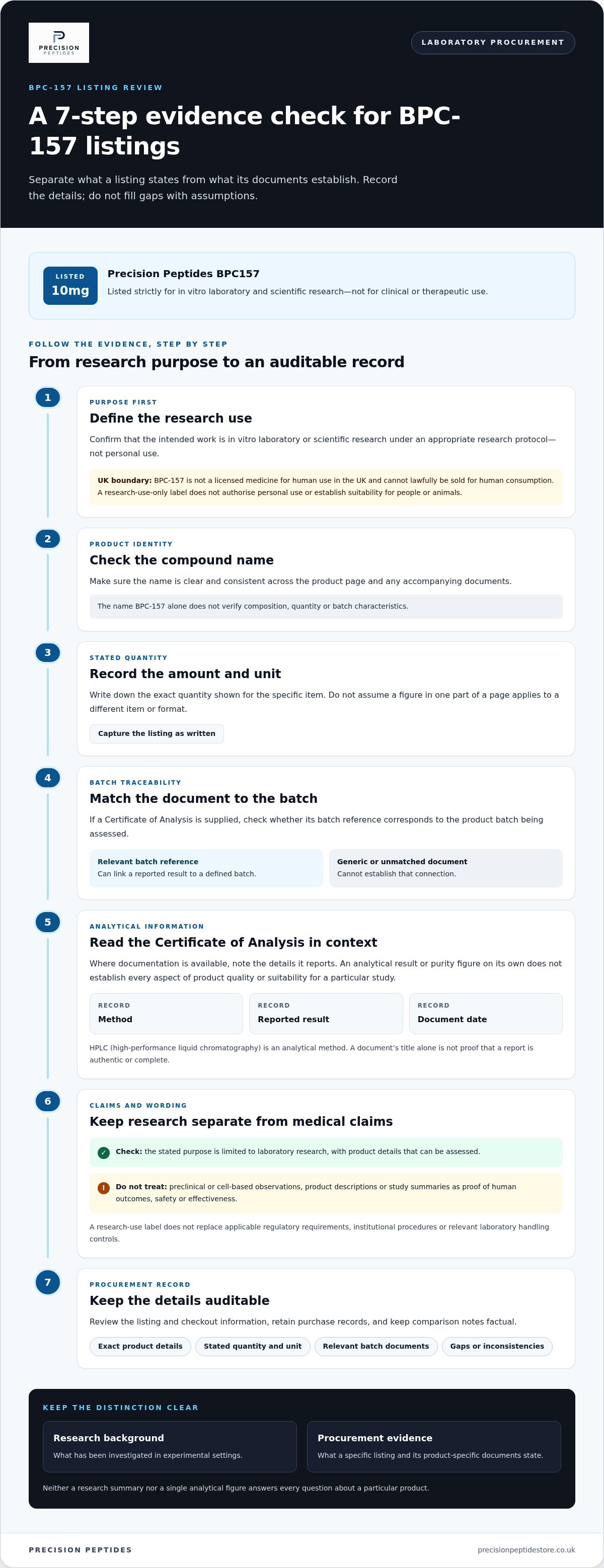
Before you buy bpc 157 uk, define the procurement purpose. This guide concerns BPC-157 for in vitro laboratory and scientific research, not personal-use products. BPC-157 is discussed in preclinical research, but that background is not evidence of established clinical benefit. Research findings, product descriptions and medical claims are different kinds of information; keep them separate when making a purchasing decision.
A research listing is not an authorised medicine. BPC-157 is not a licensed medicine for human use in the UK and cannot lawfully be sold for human consumption. A research-use-only label describes the stated research context; it does not authorise personal use or establish that a product is suitable for people or animals. The MHRA regulates medicines in the UK, including products presented with medicinal claims.
What does research-use-only mean when buying BPC-157?
For laboratory procurement, the stated purpose is controlled scientific work, such as in vitro investigation under an appropriate research protocol. A product listing is not medical advice, a treatment recommendation or guidance for personal use. The label does not replace the purchaser’s responsibility to follow applicable regulatory requirements, institutional procedures and relevant laboratory handling controls.
Keep these boundaries clear when reviewing a listing:
- Purpose: Is the intended use explicitly limited to in vitro laboratory or scientific research?
- Claims: Does the description avoid presenting the product as a treatment or making unsupported health promises?
- Use: Is the purchasing decision consistent with the research setting, rather than self-medication?
What can BPC-157 research listings tell a buyer?
The name BPC-157 identifies the peptide being offered, but the name alone does not verify a product’s composition, quantity or batch characteristics. Treat each as a separate detail to assess. The BPC-157 Wikipedia page provides general background on the compound, its research and regulatory context. It is not a substitute for primary scientific literature or product-specific documentation.
Preclinical and cell-based research can report observations in experimental settings, but it cannot establish human outcomes, safety or effectiveness. Do not transfer findings from one model directly to another, or treat a study summary as an assessment of product quality. Research background and procurement evidence answer different questions: one concerns what has been investigated, the other what a particular listing documents.
For a more focused overview of the scientific context, the BPC-157 laboratory-focused research guide examines the compound from a laboratory perspective. Use that background to frame research questions, then assess a product listing on its stated identity, quantity and documentation. This keeps purchasing decisions auditable and avoids treating research interest as proof of clinical value.
How to assess a BPC-157 UK listing: specifications and batch evidence
Separate four elements that product pages often present together: identity, stated quantity, analytical evidence and research-use wording. Apply the same checks to each listing rather than treating polished presentation or a prominent purity figure as a substitute for documentation. If you plan to buy bpc 157 uk for laboratory research, record what the listing says and distinguish those details from your own interpretation.
- Identity: Check that the compound name is clear and consistent across the product page and any accompanying documents.
- Quantity: Note the stated amount and unit. Do not assume a figure in one part of a page applies to a different item or format.
- Analytical evidence: Where documentation is supplied, review its method, reported result, batch reference and date.
- Research-use wording: Confirm that the stated purpose is laboratory research, without treatment or personal-use claims.
Which product specifications should a research buyer compare?
Compare the compound name and quantity as written, then check for consistency between the listing and supporting records. Record a format only when the specific listing identifies it. Capsule, powder or liquid descriptions on another retailer’s page are examples of that retailer’s offering, not specifications for Precision Peptides’ BPC157 10mg. Keep comparison notes factual: capture the stated details and flag any gaps or inconsistencies rather than filling them with assumptions.
How should a buyer read a BPC-157 Certificate of Analysis?
Start with traceability. A Certificate of Analysis is relevant to procurement when its batch reference clearly corresponds to the product batch being assessed. A generic or unmatched document cannot establish that connection. When a certificate is supplied, record the batch reference, analytical method, reported result and document date. These details show what the document covers, but do not by themselves establish every aspect of product quality.
Batch traceability matters because it links a reported analytical result to a defined product batch, making the evidence more auditable. It does not mean a batch has been tested unless the relevant documentation says so, and it does not guarantee that a report is authentic or complete. Assess the information in the document rather than treating its title as proof.
HPLC, or high-performance liquid chromatography, is an analytical method. A chromatogram or percentage reported from an analysis is a result to interpret in context, not proof of clinical efficacy or safety. The method describes how a sample was analysed; the reported result describes what the document records; an independent interpretation considers whether the method and result support a particular conclusion. These are related, but not interchangeable.
Precision Peptides lists BPC157 10mg for in vitro laboratory and scientific research. Apply the same four checks to the product page and use product or batch details as described in the listing and its documentation. This keeps procurement records precise and avoids attributing purity, testing or certificate claims to the product without supporting information.
BPC-157 product claims and formats: compare evidence, not promises
Different formats and promotional claims can make listings look directly comparable when they are not. For laboratory procurement, compare only details that are explicitly stated, and keep format, quantity and supporting evidence distinct. A capsule, vial or liquid description is a procurement attribute, not evidence that one format produces superior biological outcomes. None of these details establishes a research result or clinical effect.
Listing identity: Confirm the compound name as written.
Stated format: Record only the format expressly identified on that listing.
Quantity: Note the amount and unit without assuming equivalence between products.
Evidence: Record documentation actually supplied; do not infer testing from a claim.
Research-use wording: Check that the stated purpose is laboratory research.
For example, other retailer pages describe capsule, vial and pre-mixed liquid formats, with differing quantities. Those are examples of claims on those pages, not specifications for Precision Peptides’ BPC157 10mg listing. For this listing, record the product identity and stated quantity, and use documentation to assess any further product or batch information. This distinction makes a comparison more useful by separating what a supplier states from what the available evidence supports.
How do BPC-157 formats affect laboratory procurement?
Compare formats only where each listing names them clearly. A stated capsule, powder or liquid form does not establish that products are equivalent in composition, concentration or suitability for a particular experimental design. The appropriate comparison depends on the documented requirements of the laboratory project and the information provided for each listing. This section covers procurement comparisons, not handling or preparation procedures.
Keep a comparison record with the exact listing wording, stated quantity, cited evidence and date reviewed. If a detail is absent or inconsistent, mark it as unresolved rather than borrowing it from another retailer’s description. This supports accurate purchasing records and prevents an example format from being mistaken for a product specification.
How should buyers assess claims about research applications?
Claims about pathways, models or biological activity need context. A finding in a cell-based or other preclinical model applies to the conditions and methods of that study; it does not establish an effect in humans. Keep published research separate from promotional language and from the specifications of the product being procured.
Check whether a biological statement identifies a source and describes the research setting precisely. Absolute wording, such as a claim that BPC-157 definitively produces a particular outcome, should not be included in a neutral comparison unless reliable evidence supports that scope. When you buy bpc 157 uk for laboratory research, assess product details as procurement information and literature as study-specific evidence. Neither proves more than it actually addresses.
Ordering BPC-157 in the UK: check compliance and fulfilment details
A sound laboratory order depends on more than selecting an item and completing payment. Before checkout, confirm that the purchase fits a legitimate in vitro research requirement and your organisation’s procurement procedures. UK-based supply can simplify domestic purchasing, but it does not remove the purchaser’s responsibility to observe applicable requirements or ensure the product is acquired for its stated research purpose.
What should a laboratory purchaser check before checkout?
Use a consistent checklist for every order. It separates procurement essentials from retailer-specific delivery information and helps create a clear record of the purchasing decision.
- Research purpose: Confirm that the intended work is in vitro laboratory or scientific research and follows your institution’s procedures.
- Product identity: Match the name on the product page to the item selected at checkout.
- Quantity: Check the stated amount and unit against the project requirement and order summary.
- Documentation: Review product or batch documents supplied with the listing, and retain relevant records with the order.
- Checkout details: Check the item, quantity, delivery address and displayed terms before submitting the order.
Save the product description and order confirmation, along with any relevant batch documentation. These records support traceability if the purchase is later reviewed against a project file or internal purchasing record. Treat a document as batch-specific only when its identifying details connect it to the relevant batch.
Fulfilment terms are retailer-specific. Review the terms shown during the ordering process for delivery arrangements, costs and conditions. Do not infer dispatch timing, tracking, temperature controls or other service features from another supplier’s claims. Such details vary and should be assessed as stated, not treated as a UK-wide standard. Avoid relying on delivery promises or consumer-protection claims unless they are current and supported by authoritative information.
How should UK research-use boundaries be described?
Precision Peptides’ products are sold strictly for in vitro laboratory and scientific research purposes. They are not offered as clinical, therapeutic or compounded products, and the research-use description must not be taken as a recommendation for human or animal use. A supplier’s UK location does not change the stated purpose or establish that a product is suitable outside the laboratory research context.
Regulatory wording can depend on how a product is presented and intended to be used. For publication or procurement policy, verify legal statements against current authoritative UK guidance rather than relying on retailer copy alone. Keep the practical boundary clear: confirm the research purpose, follow applicable procedures and retain an auditable order record.
For eligible laboratory research procurement, the Precision Peptides catalogue presents the available research products alongside their listing and checkout details.
Buy BPC-157 from Precision Peptides for laboratory research
Precision Peptides lists BPC157 10mg for in vitro laboratory and scientific research. The product name and stated 10mg quantity give laboratory purchasers a clear starting point for their procurement record. Assess any further specification, such as format, purity, testing, batch documentation, storage or dispatch arrangements, using the information published for the product.
What is established about the Precision Peptides BPC157 10mg listing?
The catalogue identifies BPC157 10mg as a research product, restricted to in vitro laboratory and scientific research. Keep this description separate from assumptions about product characteristics or research outcomes. A listed quantity tells a purchaser the amount stated; by itself, it does not demonstrate composition, analytical results or suitability for a particular experiment. Use the product page for current listing information.
This distinction supports a disciplined decision. The product name identifies the item, the stated quantity records the declared amount, and the research-use wording defines the purchasing context. Do not extend these details into claims the listing does not make. This also avoids importing specifications from other suppliers, whose product formats, documents and claims apply to their own listings.
What is the next step for a research purchaser?
Before ordering, compare the listing with the laboratory project’s requirements and your organisation’s purchasing procedures. A practical final review includes:
- Purpose: Confirm that the intended purchase is for in vitro laboratory or scientific research.
- Listing: Match the product name and stated 10mg quantity to the item selected.
- Records: Retain the product description and order records with relevant project documentation.
These checks help maintain a clear record of what was selected and why. They do not replace an assessment of the project’s scientific requirements or applicable institutional procedures. For details that matter to the work, use information published for the product rather than inference or third-party descriptions.
Readers searching “buy bpc 157 uk” should keep the decision centred on the same framework: define the laboratory research purpose, review the listing and retain relevant records. Precision Peptides’ BPC157 10mg is presented for in vitro research, not as a clinical or therapeutic product.
Eligible laboratory purchasers can review the Precision Peptides research catalogue and its current product information.
Make your next procurement decision with clarity
A well-governed purchase begins with a defined research requirement and a record colleagues, procurement teams and project reviewers can understand later. Align the requested item with the study documentation and your organisation’s purchasing process before proceeding. This creates a clear audit trail without relying on assumptions about product attributes or research outcomes.
For UK laboratories considering where to buy bpc 157 uk, Precision Peptides is a UK-based online supplier serving customers nationally. Its catalogue includes BPC157 10mg, and its research products are restricted to in vitro laboratory and scientific research purposes. Review the catalogue information against your project requirements and proceed only where the intended use fits those boundaries.
Keep the decision proportionate: confirm the research purpose, assess the information published for the listing and retain the relevant purchasing records. A careful procurement process supports accountability from selection through record-keeping.
View the Precision Peptides research catalogue and select BPC157 10mg for eligible in vitro laboratory or scientific research.
Frequently Asked Questions
Can I buy BPC-157 in the UK for personal use?
No. Precision Peptides supplies BPC157 strictly for in vitro laboratory and scientific research, not personal use. A research listing does not authorise use in people or animals, and BPC-157 is not a licensed medicine for human use in the UK. This guide cannot provide personal-use advice. If your interest relates to a health concern or treatment decision, speak with a qualified healthcare professional rather than relying on research product descriptions.
What should I check before buying BPC-157 in the UK?
Check that the item selected matches your documented laboratory requirement. Compare the product name and stated quantity with the checkout summary, and record format or batch details when the listing explicitly provides them. If you buy bpc 157 uk for research, retain the product description and order confirmation with your procurement records. Treat purity, testing and fulfilment statements as claims about that particular listing, not universal standards.
How can I verify a BPC-157 Certificate of Analysis?
Match the document’s batch identifier to the batch named for the product, then review the analytical method, reported result and document date. A certificate without a matching batch reference cannot establish that it applies to the item being procured. A document may support traceability, but it does not establish clinical efficacy, safety or suitability for human or animal use. Preserve it with the relevant order record.
Is BPC-157 approved as a medicine in the UK?
No. BPC-157 is not a licensed medicine for human use in the UK. It is not controlled under the Misuse of Drugs Act 1971, but that does not make it an authorised medicine or permit a research product to be treated as one. The MHRA regulates medicines and medicinal claims. For a current regulatory determination, consult relevant UK authority guidance rather than relying solely on wording in a retailer’s listing.
What does BPC157 10mg mean on a product listing?
It identifies the listed product as BPC157 and states a quantity of 10mg. That figure alone does not specify the product’s format, concentration, purity or analytical profile, so avoid drawing those conclusions from the name. Precision Peptides lists BPC157 10mg for in vitro laboratory and scientific research. Use the full current product description for any further published specifications relevant to your procurement assessment.
Can research-use BPC-157 be used for treatment or self-experimentation?
No. Precision Peptides’ research products are supplied for in vitro laboratory and scientific research, not for human or animal consumption, diagnosis or treatment. Findings from laboratory models do not provide personal-use instructions or establish treatment effects. This article does not offer dosing, administration or self-experimentation guidance. If you have a health concern or are considering treatment, consult a qualified healthcare professional for advice appropriate to your circumstances.
Frequently Asked Questions
For laboratory procurement, the stated purpose is controlled scientific work, such as in vitro investigation under an appropriate research protocol. A product listing is not medical advice, a treatment recommendation or guidance for personal use. The label does not replace the purchaser’s responsibility to follow applicable regulatory requirements, institutional procedures and relevant laboratory handling controls. Keep these boundaries clear when reviewing a listing:
The name BPC-157 identifies the peptide being offered, but the name alone does not verify a product’s composition, quantity or batch characteristics. Treat each as a separate detail to assess. The BPC-157 Wikipedia page provides general background on the compound, its research and regulatory context. It is not a substitute for primary scientific literature or product-specific documentation. Preclinical and cell-based research can report observations in experimental settings, but it cannot establish human outcomes, safety or effectiveness. Do not transfer findings from one model directly to another, or treat a study summary as an assessment of product quality. Research background and procurement evidence answer different questions: one concerns what has been investigated, the other what a particular listing documents. For a more focused overview of the scientific context, the BPC-157 laboratory-focused research guide examines the compound from a laboratory perspective. Use that background to frame research questions, then assess a product listing on its stated identity, quantity and documentation. This keeps purchasing decisions auditable and avoids treating research interest as proof of clinical value. Separate four elements that product pages often present together: identity, stated quantity, analytical evidence and research-use wording. Apply the same checks to each listing rather than treating polished presentation or a prominent purity figure as a substitute for documentation. If you plan to buy bpc 157 uk for laboratory research, record what the listing says and distinguish those details from your own interpretation.
Compare the compound name and quantity as written, then check for consistency between the listing and supporting records. Record a format only when the specific listing identifies it. Capsule, powder or liquid descriptions on another retailer’s page are examples of that retailer’s offering, not specifications for Precision Peptides’ BPC157 10mg. Keep comparison notes factual: capture the stated details and flag any gaps or inconsistencies rather than filling them with assumptions.
Start with traceability. A Certificate of Analysis is relevant to procurement when its batch reference clearly corresponds to the product batch being assessed. A generic or unmatched document cannot establish that connection. When a certificate is supplied, record the batch reference, analytical method, reported result and document date. These details show what the document covers, but do not by themselves establish every aspect of product quality. Batch traceability matters because it links a reported analytical result to a defined product batch, making the evidence more auditable. It does not mean a batch has been tested unless the relevant documentation says so, and it does not guarantee that a report is authentic or complete. Assess the information in the document rather than treating its title as proof. HPLC, or high-performance liquid chromatography, is an analytical method. A chromatogram or percentage reported from an analysis is a result to interpret in context, not proof of clinical efficacy or safety. The method describes how a sample was analysed; the reported result describes what the document records; an independent interpretation considers whether the method and result support a particular conclusion. These are related, but not interchangeable. Precision Peptides lists BPC157 10mg for in vitro laboratory and scientific research. Apply the same four checks to the product page and use product or batch details as described in the listing and its documentation. This keeps procurement records precise and avoids attributing purity, testing or certificate claims to the product without supporting information. Different formats and promotional claims can make listings look directly comparable when they are not. For laboratory procurement, compare only details that are explicitly stated, and keep format, quantity and supporting evidence distinct. A capsule, vial or liquid description is a procurement attribute, not evidence that one format produces superior biological outcomes. None of these details establishes a research result or clinical effect. Listing identity: Confirm the compound name as written. Stated format: Record only the format expressly identified on that listing. Quantity: Note the amount and unit without assuming equivalence between products. Evidence: Record documentation actually supplied; do not infer testing from a claim. Research-use wording: Check that the stated purpose is laboratory research. For example, other retailer pages describe capsule, vial and pre-mixed liquid formats, with differing quantities. Those are examples of claims on those pages, not specifications for Precision Peptides’ BPC157 10mg listing. For this listing, record the product identity and stated quantity, and use documentation to assess any further product or batch information. This distinction makes a comparison more useful by separating what a supplier states from what the available evidence supports.
Compare formats only where each listing names them clearly. A stated capsule, powder or liquid form does not establish that products are equivalent in composition, concentration or suitability for a particular experimental design. The appropriate comparison depends on the documented requirements of the laboratory project and the information provided for each listing. This section covers procurement comparisons, not handling or preparation procedures. Keep a comparison record with the exact listing wording, stated quantity, cited evidence and date reviewed. If a detail is absent or inconsistent, mark it as unresolved rather than borrowing it from another retailer’s description. This supports accurate purchasing records and prevents an example format from being mistaken for a product specification.
Claims about pathways, models or biological activity need context. A finding in a cell-based or other preclinical model applies to the conditions and methods of that study; it does not establish an effect in humans. Keep published research separate from promotional language and from the specifications of the product being procured. Check whether a biological statement identifies a source and describes the research setting precisely. Absolute wording, such as a claim that BPC-157 definitively produces a particular outcome, should not be included in a neutral comparison unless reliable evidence supports that scope. When you buy bpc 157 uk for laboratory research, assess product details as procurement information and literature as study-specific evidence. Neither proves more than it actually addresses. A sound laboratory order depends on more than selecting an item and completing payment. Before checkout, confirm that the purchase fits a legitimate in vitro research requirement and your organisation’s procurement procedures. UK-based supply can simplify domestic purchasing, but it does not remove the purchaser’s responsibility to observe applicable requirements or ensure the product is acquired for its stated research purpose.
Use a consistent checklist for every order. It separates procurement essentials from retailer-specific delivery information and helps create a clear record of the purchasing decision. Save the product description and order confirmation, along with any relevant batch documentation. These records support traceability if the purchase is later reviewed against a project file or internal purchasing record. Treat a document as batch-specific only when its identifying details connect it to the relevant batch. Fulfilment terms are retailer-specific. Review the terms shown during the ordering process for delivery arrangements, costs and conditions. Do not infer dispatch timing, tracking, temperature controls or other service features from another supplier’s claims. Such details vary and should be assessed as stated, not treated as a UK-wide standard. Avoid relying on delivery promises or consumer-protection claims unless they are current and supported by authoritative information.
Precision Peptides’ products are sold strictly for in vitro laboratory and scientific research purposes. They are not offered as clinical, therapeutic or compounded products, and the research-use description must not be taken as a recommendation for human or animal use. A supplier’s UK location does not change the stated purpose or establish that a product is suitable outside the laboratory research context. Regulatory wording can depend on how a product is presented and intended to be used. For publication or procurement policy, verify legal statements against current authoritative UK guidance rather than relying on retailer copy alone. Keep the practical boundary clear: confirm the research purpose, follow applicable procedures and retain an auditable order record. For eligible laboratory research procurement, the Precision Peptides catalogue presents the available research products alongside their listing and checkout details. Precision Peptides lists BPC157 10mg for in vitro laboratory and scientific research. The product name and stated 10mg quantity give laboratory purchasers a clear starting point for their procurement record. Assess any further specification, such as format, purity, testing, batch documentation, storage or dispatch arrangements, using the information published for the product.
The catalogue identifies BPC157 10mg as a research product, restricted to in vitro laboratory and scientific research. Keep this description separate from assumptions about product characteristics or research outcomes. A listed quantity tells a purchaser the amount stated; by itself, it does not demonstrate composition, analytical results or suitability for a particular experiment. Use the product page for current listing information. This distinction supports a disciplined decision. The product name identifies the item, the stated quantity records the declared amount, and the research-use wording defines the purchasing context. Do not extend these details into claims the listing does not make. This also avoids importing specifications from other suppliers, whose product formats, documents and claims apply to their own listings.
Before ordering, compare the listing with the laboratory project’s requirements and your organisation’s purchasing procedures. A practical final review includes: These checks help maintain a clear record of what was selected and why. They do not replace an assessment of the project’s scientific requirements or applicable institutional procedures. For details that matter to the work, use information published for the product rather than inference or third-party descriptions. Readers searching “buy bpc 157 uk” should keep the decision centred on the same framework: define the laboratory research purpose, review the listing and retain relevant records. Precision Peptides’ BPC157 10mg is presented for in vitro research, not as a clinical or therapeutic product. Eligible laboratory purchasers can review the Precision Peptides research catalogue and its current product information. A well-governed purchase begins with a defined research requirement and a record colleagues, procurement teams and project reviewers can understand later. Align the requested item with the study documentation and your organisation’s purchasing process before proceeding. This creates a clear audit trail without relying on assumptions about product attributes or research outcomes. For UK laboratories considering where to buy bpc 157 uk, Precision Peptides is a UK-based online supplier serving customers nationally. Its catalogue includes BPC157 10mg, and its research products are restricted to in vitro laboratory and scientific research purposes. Review the catalogue information against your project requirements and proceed only where the intended use fits those boundaries. Keep the decision proportionate: confirm the research purpose, assess the information published for the listing and retain the relevant purchasing records. A careful procurement process supports accountability from selection through record-keeping. View the Precision Peptides research catalogue and select BPC157 10mg for eligible in vitro laboratory or scientific research.
No. Precision Peptides supplies BPC157 strictly for in vitro laboratory and scientific research, not personal use. A research listing does not authorise use in people or animals, and BPC-157 is not a licensed medicine for human use in the UK. This guide cannot provide personal-use advice. If your interest relates to a health concern or treatment decision, speak with a qualified healthcare professional rather than relying on research product descriptions.
Check that the item selected matches your documented laboratory requirement. Compare the product name and stated quantity with the checkout summary, and record format or batch details when the listing explicitly provides them. If you buy bpc 157 uk for research, retain the product description and order confirmation with your procurement records. Treat purity, testing and fulfilment statements as claims about that particular listing, not universal standards.
Match the document’s batch identifier to the batch named for the product, then review the analytical method, reported result and document date. A certificate without a matching batch reference cannot establish that it applies to the item being procured. A document may support traceability, but it does not establish clinical efficacy, safety or suitability for human or animal use. Preserve it with the relevant order record.
No. BPC-157 is not a licensed medicine for human use in the UK. It is not controlled under the Misuse of Drugs Act 1971, but that does not make it an authorised medicine or permit a research product to be treated as one. The MHRA regulates medicines and medicinal claims. For a current regulatory determination, consult relevant UK authority guidance rather than relying solely on wording in a retailer’s listing.
It identifies the listed product as BPC157 and states a quantity of 10mg. That figure alone does not specify the product’s format, concentration, purity or analytical profile, so avoid drawing those conclusions from the name. Precision Peptides lists BPC157 10mg for in vitro laboratory and scientific research. Use the full current product description for any further published specifications relevant to your procurement assessment.
No. Precision Peptides’ research products are supplied for in vitro laboratory and scientific research, not for human or animal consumption, diagnosis or treatment. Findings from laboratory models do not provide personal-use instructions or establish treatment effects. This article does not offer dosing, administration or self-experimentation guidance. If you have a health concern or are considering treatment, consult a qualified healthcare professional for advice appropriate to your circumstances.