

TB-500 10mg Research Peptide: A Laboratory Reference Guide
10 October 2026 · 15 min read
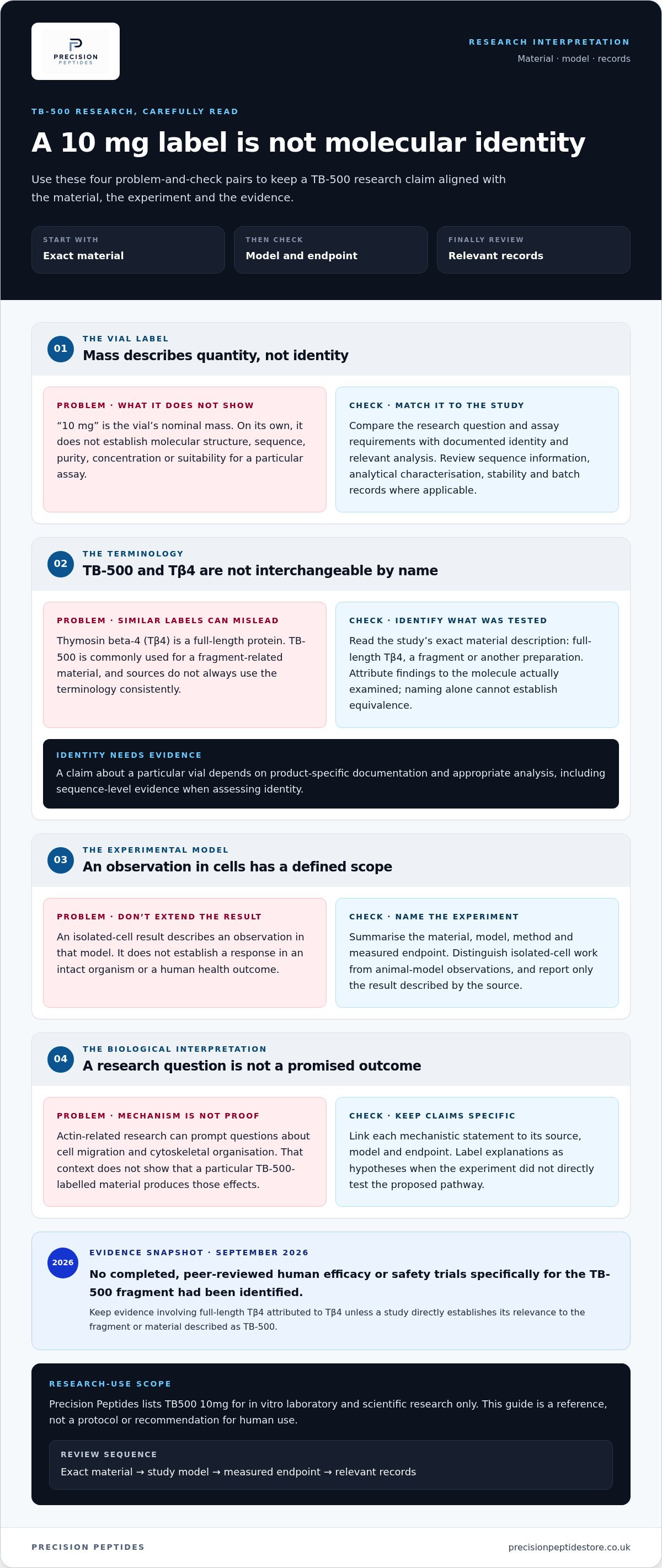
A 10 mg label describes vial mass, not molecular identity. For a tb-500 10mg research peptide, that distinction matters: TB-500 is often used to describe a short synthetic fragment, whilst some cited studies investigate full-length thymosin beta-4 (Tβ4), a different molecule. The terms aren’t interchangeable, and findings for one can’t automatically be applied to the other.
Terminology and preclinical findings can make the evidence difficult to interpret. Laboratory observations, including in vitro results, don’t establish human outcomes. As of September 2026, no completed, peer-reviewed human efficacy or safety trials specifically for the TB-500 fragment had been identified. This guide explains what the terminology can mean, what the research does and doesn’t show, and what to consider when evaluating a research-use-only compound.
It covers the distinction between TB-500 and Tβ4, the limits of in vitro evidence, and the records and analytical details relevant to interpreting a sample. Precision Peptides lists TB500 10mg for in vitro laboratory and scientific research only. Vial mass alone doesn’t verify identity, purity or assay suitability.
Key Takeaways
- Use the study’s exact material description to distinguish research on TB-500-labelled material from research on full-length thymosin beta-4.
- Assess actin-associated research through specific questions about cell migration and cytoskeletal organisation, not as evidence of a promised outcome.
- When reviewing a tb-500 10mg research peptide, organise the evaluation around the research question, source literature, material identity and relevant records.
- Look for sequence-level evidence when assessing identity claims, and consider whether the analytical information is relevant to the intended assay.
- Precision Peptides lists TB500 10mg for in vitro laboratory and scientific research. This guide is a reference, not a protocol or recommendation for human use.
What does TB-500 10mg mean in a research context?
TB-500 is a research-labelled peptide term, not a clinical indication. In a laboratory setting, the name describes how a material is labelled, but it doesn’t establish a defined molecular structure or what a particular sample can demonstrate. The label “10mg” states the vial’s nominal mass; it isn’t evidence of identity, purity or suitability for a specific assay.
Commercial and scientific sources don’t always use TB-500 terminology consistently. A paper may describe a specific molecule, whilst a product label may use a broader name. Compare the exact material description in each source rather than assuming that similarly named materials are equivalent.
For a concise overview of the terminology, Wikipedia’s TB-500 entry summarises the fragment terminology and its described relationship to thymosin beta-4. Treat it as general background, not confirmation of the identity or characterisation of a particular vial.
This video discusses claims associated with TB-500. Consider its content alongside primary literature and laboratory records.
TB-500 and thymosin beta-4: why the names need care
Thymosin beta-4 (Tβ4) is a full-length protein, whilst TB-500 is commonly used for a fragment-related material. Sources may apply these terms differently, so check whether a paper specifies full-length Tβ4, a fragment or another preparation. Naming alone can’t establish equivalence. An identity claim requires sequence-level evidence that corresponds to the material under study.
Attribute findings to the molecule and preparation actually examined. A result reported for full-length Tβ4 doesn’t automatically describe a TB-500-labelled fragment. Likewise, a general description of a commonly referenced fragment doesn’t establish the sequence of a particular vial. That determination depends on product-specific documentation and appropriate analysis.
What the 10mg vial quantity does, and does not, tell a researcher
Nominal mass is a quantity statement, not a concentration or purity measurement. It doesn’t show how much of the stated material is present, identify its sequence or establish whether it meets an assay’s requirements. For example, a mass label alone can’t show whether a sample is appropriate for a study designed around a particular molecular target.
Assess suitability against the research question, the material’s documented identity and the assay’s requirements. Relevant considerations may include sequence information, analytical characterisation, stability and batch records, where applicable. A tb-500 10mg research peptide label is a starting point for record review, not a substitute for it. Precision Peptides lists TB500 10mg for in vitro laboratory and scientific research only.
What biological questions do TB-500-related studies investigate?
TB-500-related research is often discussed in connection with actin, a protein involved in cellular structure and movement. This context can guide questions about cytoskeletal organisation and cell migration, but it doesn’t establish that a particular TB-500-labelled material produces those effects. Interpretation depends on the molecule tested, the experimental model and the measured endpoint.
A finding in isolated cells describes an observation within that model, not a response in an intact organism or a human health outcome. Evidence involving full-length thymosin beta-4 (Tβ4) must also remain attributed to Tβ4 unless the study directly establishes its relevance to the fragment or material described as TB-500.
Actin and cell-migration research in experimental models
Before summarising a paper, record the material, model, method and endpoint. Distinguish, for example, an isolated-cell migration assay from an animal-model observation. Note whether the endpoint concerns cell movement, cytoskeletal organisation or another feature. A clear summary names the model and assay, then reports only the result described by the source.
Label mechanistic explanations as hypotheses when the experiment doesn’t directly test the proposed pathway. An observed change in cell behaviour doesn’t establish a universal response, a whole-organism effect or a clinical benefit. Any inference is limited by the study design and the material actually examined.
How to describe evidence without overstating it
Classify evidence by level: isolated cells, animal models or human studies. Then state the measured outcome and the main limitation. If a paper tests Tβ4, don’t describe it as a TB-500 experiment. If it tests a TB-500-labelled preparation, don’t infer a verified sequence unless the source establishes one. This keeps terminology, method and conclusion aligned.
The World Anti-Doping Agency’s research into human metabolism addresses a different question from efficacy: WADA describes research into the human metabolism of TB-500. Its existence doesn’t demonstrate a beneficial biological effect or establish clinical outcomes. It does show why metabolism, identity and activity should be treated as separate research questions.
For a tb-500 10mg research peptide, connect every mechanistic statement to the exact source, model and endpoint, and flag where the evidence doesn’t support broader conclusions. The TB500 10mg research offering is listed for in vitro laboratory and scientific research only; product context is separate from evidence claims.
Is TB-500 the same as thymosin beta-4? Assessing evidence and limitations
No. TB-500 and thymosin beta-4 (Tβ4) are related terms in research discussions, but they shouldn’t be treated as interchangeable names for one verified material. Tβ4 refers to the full-length protein; TB-500 is commonly used for a fragment-related peptide, although terminology can vary between commercial descriptions and scientific sources. Attribute evidence to the material actually studied.
Molecular identity, an in vitro observation and a clinical outcome are three different claims. A proposed mechanism doesn’t prove therapeutic benefit, and a laboratory observation doesn’t establish human safety. Each conclusion requires evidence at the appropriate level.
| Term or evidence | Source context | What it establishes |
|---|---|---|
| Thymosin beta-4 (Tβ4) | Full-length protein described in scientific literature | Evidence applies to the tested Tβ4 preparation and study conditions. |
| TB-500-labelled material | Commercial or study terminology that may refer to a fragment-related peptide | The label alone doesn’t establish a sequence or equivalence with Tβ4. |
| In vitro result | Isolated cells or other laboratory system | A measured response in that model, not human efficacy or safety. |
| Human clinical evidence | Studies involving people | Must be assessed separately; preclinical findings cannot substitute for it. |
How to compare TB-500-labelled material with thymosin beta-4 papers
Start with each paper’s terminology, reported sequence and experimental material. Check whether the authors tested full-length Tβ4, a specified fragment or another preparation, then compare methods and endpoints before considering related findings. Keep a commercial label separate from a compound name used in a primary publication. If sequence-level identity isn’t established, record the match as unresolved rather than infer equivalence.
This standard applies to a tb-500 10mg research peptide too: its name and vial quantity aren’t sequence evidence. A product-specific identity claim requires suitable documentation or analysis. Don’t transfer findings from a differently characterised material without justification.
What in vitro evidence cannot establish
Cell-based findings can identify a biological endpoint under defined experimental conditions. On their own, they can’t establish human efficacy, safety, appropriate dosing or an approved clinical indication. Even a plausible mechanism remains a research hypothesis until supported by evidence designed to test the relevant outcome.
Keep summaries tied to their source: identify the model, material and measured endpoint, then state the study’s limitations. Exclude anecdotes and unsupported claims from a scientific assessment. Precision Peptides lists TB500 10mg for in vitro laboratory and scientific research; this context doesn’t imply human-use suitability or clinical benefit.
How should researchers evaluate TB-500 information for a laboratory study?
Evaluate a proposed research material against the question the study is designed to answer. A disciplined review links the research question to relevant literature, the material’s stated identity, relevant analytical records and the assay’s requirements. This helps prevent a product description from being mistaken for evidence that a sample is suitable for a particular experiment.
The label “10mg” records a stated mass only. It can’t establish sequence, purity, stability or analytical suitability. Those questions require relevant documentation and, where necessary, methods suited to the property being assessed. Don’t infer results that aren’t reported in the records.
A four-part framework for reviewing research material
Use the same review categories for each study or material. Record what is documented and what remains unknown so later interpretation doesn’t rely on assumptions.
- Research question: Define the biological question and whether the intended work is in vitro. Select literature and a model relevant to that question, rather than relying on broad claims about related compounds.
- Source literature: Note the paper’s terminology, experimental material, model, method and measured endpoint. Separate findings for thymosin beta-4 from findings for a TB-500-labelled preparation.
- Material identity: Review identity information at the level needed for the research question. Sequence claims require sequence-level support; a label or nominal mass alone doesn’t provide it.
- Records and provenance: Review relevant analytical and batch records without assuming a test was performed or a particular result obtained. Record provenance and lot identifiers where applicable, alongside any gaps that limit interpretation.
Purity, stability and assay compatibility are distinct considerations. A record addressing one doesn’t automatically answer the others. A nominal mass statement, for instance, doesn’t establish the proportion of the intended molecule in a sample. An identity claim alone doesn’t show that the material meets a study’s analytical requirements. Tie each conclusion to the evidence that supports it.
Keep study interpretation reproducible and bounded
Laboratory records should make the reasoning traceable. Document the study model, material description, method, measured endpoint and relevant limitations. Distinguish direct observations from interpretation: a measured change under defined conditions is an observation; an explanation of why it occurred may remain a hypothesis.
State unresolved questions plainly. If the material’s identity or a study condition isn’t established, record that uncertainty rather than generalising from a similar name or a different experimental system. These boundaries help colleagues assess reproducibility and determine how much weight a finding can reasonably carry.
Precision Peptides lists TB500 10mg for in vitro laboratory and scientific research only. To review the tb-500 10mg research peptide offering in that context, view TB500 10mg for laboratory research.
TB500 10mg for in vitro research: scope, responsible use and next steps
This guide is a laboratory reference, not an experimental protocol or a recommendation for human use. Precision Peptides lists TB500 10mg for in vitro laboratory and scientific research purposes only. It isn’t offered as a clinical or therapeutic human-use medicine. Research terminology and preclinical observations shouldn’t be read as advice about treatment, administration or self-experimentation.
Before interpreting a result, keep three checks in view: terminology, evidence context and material documentation. Confirm what molecule or preparation a source describes, identify the model and endpoint behind its findings, and assess what records support claims about the material. A label, a laboratory observation and a clinical conclusion are different kinds of information.
Research-use-only boundaries
TB500 10mg is presented here in a research-use context. This section doesn’t provide dosing, administration, treatment or self-experimentation guidance, nor does it establish that findings from an in vitro system predict effects in people. Any legal or regulatory question requires current, authoritative information relevant to the specific jurisdiction; this reference doesn’t make a legal determination.
Keep product information separate from claims about biological activity or human outcomes. A stated mass or product name doesn’t, by itself, confirm identity, purity, assay suitability, safety or efficacy. Those conclusions require relevant evidence and must not be inferred from the research-use label.
A concise reference checklist before interpreting a study
Use these checks to keep a literature review clear and auditable:
- Confirm the terminology: Record the compound name and any sequence or preparation specified by the source. Distinguish TB-500-labelled material from full-length thymosin beta-4, and note when identity remains unresolved.
- Define the evidence context: Identify whether the study uses isolated cells, an animal model or human participants. Record the method and measured endpoint, then distinguish what was observed from what the authors propose it may mean.
- Document the limits: Note relevant study conditions, material information and uncertainties. Don’t extend a result beyond the model, preparation or endpoint tested, and don’t present an experimental observation as a clinical outcome or approved indication.
This approach keeps conclusions proportionate to the evidence. If a study reports a change in a cellular endpoint, describe it in those terms; don’t turn it into a claim about treatment, human safety or a universal response. Where material documentation doesn’t resolve identity or analytical questions, state the gap plainly.
For laboratory teams seeking a research-use reference point, Precision Peptides lists TB500 10mg for in vitro research. Consider terminology, evidence and material records separately before drawing conclusions from a study.
Carry careful interpretation into your next research review
Define what your study can establish before interpreting what its findings might mean. Set out the research question, the evidence needed to address it and the uncertainties that would remain. This makes discussion more precise and helps prevent a promising observation from becoming a claim the data can’t support.
When assessing a tb-500 10mg research peptide, keep the scientific question distinct from the material description and any broader interpretation. Precision Peptides lists TB500 10mg as a research offering for in vitro laboratory and scientific research only. It is intended for laboratory research, not clinical or therapeutic human use.
If this material is relevant to your laboratory research, view TB500 10mg for in vitro research. Start with a clear research question, careful source assessment and appropriately bounded conclusions.
Frequently Asked Questions
Is TB-500 the same as thymosin beta-4?
No. Thymosin beta-4 is a full-length protein, whilst TB-500 is commonly used to describe a fragment-related peptide. Similar naming doesn’t prove that two materials share the same sequence or experimental properties. When comparing sources, check the molecule and preparation described in the methods, not only the title or abstract. If a paper doesn’t clearly identify its material, treat comparisons with other preparations as uncertain.
What does 10mg mean on a TB-500 research peptide vial?
It states the nominal mass attributed to the vial’s contents. It doesn’t give the concentration in a prepared sample, indicate how much is the intended molecule or show whether the material suits a particular analytical method. A researcher assessing a defined molecular target needs information relevant to that target and assay, not just the vial quantity. Don’t use the mass label to infer experimental or human-use quantities.
What is TB-500 studied for in laboratory research?
Related research examines questions involving actin-associated cellular processes, including cell movement and cytoskeletal organisation. Other proposed areas, such as angiogenesis or inflammatory responses, require careful attribution to the specific material and model examined. A useful literature note records whether the source studied isolated cells or an animal model, what endpoint it measured, and whether it tested TB-500-labelled material or thymosin beta-4. These distinctions help prevent broad claims based on a narrower experiment.
Can in vitro TB-500 findings establish effects in humans?
No. An in vitro experiment can report an observation in its defined laboratory system, but it can’t establish that the same response occurs in people. A change in a cell-based endpoint, for example, doesn’t demonstrate a clinical benefit, human safety or an appropriate dose. Human outcomes require relevant evidence from studies involving people. Keep conclusions limited to the material, conditions and endpoints examined, and label proposed explanations as hypotheses where appropriate.
Does a 10mg label confirm the identity or purity of TB-500?
No. The quantity on a label isn’t sequence evidence or a purity result. These are separate characteristics that require suitable supporting records or analytical evidence. When reviewing a tb-500 10mg research peptide, note which identity and purity information is documented, and distinguish measured results from assumptions. If sequence or purity data aren’t available to the researcher, record that limitation rather than treating the name or mass as confirmation.
Is TB500 10mg from Precision Peptides intended for human use?
No. Precision Peptides describes TB500 10mg as intended strictly for in vitro laboratory and scientific research. It isn’t offered as a clinical or therapeutic medicine for human use. The product context doesn’t provide instructions for administration, treatment or self-experimentation. Interpret associated scientific literature according to its study design, and don’t treat laboratory discussion as personal medical guidance or evidence of human suitability.
Frequently Asked Questions
No. Thymosin beta-4 is a full-length protein, whilst TB-500 is commonly used to describe a fragment-related peptide. Similar naming doesn’t prove that two materials share the same sequence or experimental properties. When comparing sources, check the molecule and preparation described in the methods, not only the title or abstract. If a paper doesn’t clearly identify its material, treat comparisons with other preparations as uncertain.
It states the nominal mass attributed to the vial’s contents. It doesn’t give the concentration in a prepared sample, indicate how much is the intended molecule or show whether the material suits a particular analytical method. A researcher assessing a defined molecular target needs information relevant to that target and assay, not just the vial quantity. Don’t use the mass label to infer experimental or human-use quantities.
Related research examines questions involving actin-associated cellular processes, including cell movement and cytoskeletal organisation. Other proposed areas, such as angiogenesis or inflammatory responses, require careful attribution to the specific material and model examined. A useful literature note records whether the source studied isolated cells or an animal model, what endpoint it measured, and whether it tested TB-500-labelled material or thymosin beta-4. These distinctions help prevent broad claims based on a narrower experiment.
No. An in vitro experiment can report an observation in its defined laboratory system, but it can’t establish that the same response occurs in people. A change in a cell-based endpoint, for example, doesn’t demonstrate a clinical benefit, human safety or an appropriate dose. Human outcomes require relevant evidence from studies involving people. Keep conclusions limited to the material, conditions and endpoints examined, and label proposed explanations as hypotheses where appropriate.
No. The quantity on a label isn’t sequence evidence or a purity result. These are separate characteristics that require suitable supporting records or analytical evidence. When reviewing a tb-500 10mg research peptide, note which identity and purity information is documented, and distinguish measured results from assumptions. If sequence or purity data aren’t available to the researcher, record that limitation rather than treating the name or mass as confirmation.
No. Precision Peptides describes TB500 10mg as intended strictly for in vitro laboratory and scientific research. It isn’t offered as a clinical or therapeutic medicine for human use. The product context doesn’t provide instructions for administration, treatment or self-experimentation. Interpret associated scientific literature according to its study design, and don’t treat laboratory discussion as personal medical guidance or evidence of human suitability.