

Wolverine Peptide Blend 20mg: A Laboratory Research Reference
7 October 2026 · 15 min read
A 20mg label is not, by itself, a complete formulation record. The name wolverine peptide blend 20mg identifies a research product, but the label alone does not establish its ingredients or the amount of each component. Use product-specific documentation, rather than assumptions based on the name, to describe what the material contains.
This distinction matters when comparing a blend-based study design with one using separate compounds. A blend affects what can be attributed to an experimental result, while missing formulation details can further limit interpretation. This guide explains how to assess the 20mg designation, review composition and batch records, and decide whether a blend fits a defined laboratory research question.
Precision Peptides supplies Wolverine 20mg for in vitro laboratory and scientific research, not for human use. The focus here is careful product identification, traceable documentation and responsible interpretation, so marketing language is not mistaken for evidence of clinical effect or safety.
Key Takeaways
- Read the wolverine peptide blend 20mg designation as a product label, not as evidence of specific ingredients or proportions.
- Use product-specific documentation to distinguish compound identity, stated quantity and batch identity.
- Compare blend-based and separate-compound study designs by considering attribution, controls and interpretation limits.
- Check that product names and batch identifiers are consistent across the records you use.
- Match the material to an in vitro research question, and interpret analytical records as measurements, not evidence of human suitability or outcomes.
Wolverine Peptide Blend 20mg: What the Product Name Does, and Does Not, Tell You
Precision Peptides offers Wolverine 20mg as a research blend for laboratory and scientific research. The product name identifies the offering, but it does not, on its own, specify the blend’s ingredients, the quantity of each component or their proportions. Use current, product-specific documentation for those details.
This distinction is central when evaluating the wolverine peptide blend 20mg. A label is an identifier, not a complete formulation record. In study notes, describe the material using documented details rather than assumptions based on a familiar product name.
The following video discusses the Wolverine stack in a broader context. It is not product-specific documentation or a source of directions for use. The product’s stated research-use scope remains the relevant boundary.
How to interpret the Wolverine 20mg designation
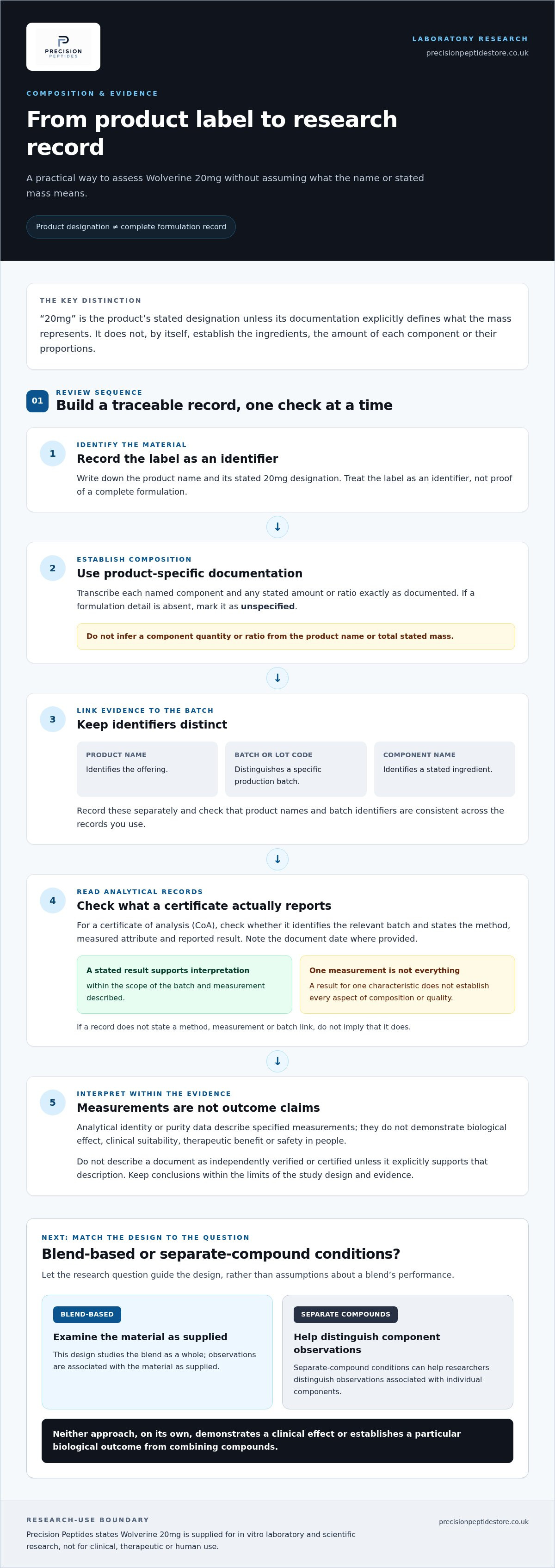
Treat “20mg” as the product’s stated designation unless its documentation explicitly defines what the mass represents. Even if records identify a total labelled mass, that does not tell you the amount or proportion of each ingredient unless those are stated separately. Do not calculate component quantities using an assumed ratio. In research records, distinguish the label, product description and batch identifier, and note any details the documentation does not specify.
General references can clarify terminology, but they cannot verify a particular blend. For example, Peptide Synthesis provides background on how peptides are made. It does not establish this product’s composition, identity or analytical status.
Research-use scope and limits
Supplier-stated scope: “Wolverine 20mg is supplied strictly for in vitro laboratory and scientific research, not for clinical, therapeutic or human use.” This states the product’s research-use boundary. It is not a treatment claim or a recommendation for human application.
Keep laboratory observations and hypotheses separate from conclusions about clinical effects or safety. This article provides no human-use directions, dosing guidance or therapeutic interpretation. In a research record, describe only what the product documentation supports, identify the material and batch clearly, and keep conclusions within the limits of the study design and evidence.
Wolverine Blend Composition and Evidence: What Laboratory Readers Should Examine
Assessing a blend involves more than recognising its name. For the wolverine peptide blend 20mg, use current product-specific documentation to establish which compounds are named and whether quantities are assigned to them. The product designation alone does not confirm ingredients, proportions, analytical results or the identity of a particular batch.
Keep three types of information distinct: compound identity describes what the documentation says is present; stated quantity records the mass attributed to the product or a component; and batch identity links the material to a particular production lot. One detail cannot replace another. A stated total mass, for example, does not establish a component ratio.
Composition, identifiers and formulation details
Start with the product-specific description and any associated records. Transcribe each named component and any stated amount or ratio as written. If a formulation detail is absent, mark it as unspecified in the research record. Do not infer it from the product name or from descriptions of similarly named blends.
Identifiers help organise evidence, but they do not demonstrate biological activity. A product name labels the offering, a batch or lot code distinguishes a specific production batch, and a component name identifies a stated ingredient. Record these separately to maintain a clear audit trail and make later comparisons more reliable.
Reading batch-level analytical records
A certificate of analysis (CoA) can support interpretation when it identifies the relevant batch and states the analytical method, the attribute measured and the reported result. Check the document’s scope carefully. A result for one measured characteristic does not establish every aspect of composition or quality. If the record does not state a method, measurement or batch link, do not imply that it does.
Analytical identity or purity data describe specified measurements; they do not demonstrate biological effect. A CoA is not, by itself, evidence of clinical suitability, therapeutic benefit or safety in people. Do not describe a document as independently verified or certified unless it explicitly supports that description.
For a consistent research record, transcribe the product name and batch identifier as shown. Then note the document date, stated method and measured attribute where provided. This preserves traceability without extending conclusions beyond the record.
When reviewing the Wolverine 20mg research blend, use this framework to keep formulation details and batch evidence distinct, and assess each only within its documented scope.
Blend Versus Separate Compounds: Choosing a Suitable In Vitro Study Design
Let the research question guide the study design, rather than assumptions about a blend’s performance. A blend-based design examines the material as supplied. Separate-compound conditions can help researchers distinguish observations associated with individual components. Neither approach, on its own, demonstrates a clinical effect or establishes that combining compounds produces a particular biological outcome.
When a blend-based design may fit a research question
A blend may suit a question about the combined material as a defined experimental input. Before interpreting results, establish its documented composition and batch identity. If component quantities or ratios are unspecified, record that limitation. The wolverine peptide blend 20mg designation alone cannot resolve it.
This has a direct effect on attribution. If several components are present and are not varied independently, an observed response cannot readily be assigned to one component or to an interaction between them. A related example of a product described as a blend is the KLOW 80mg research profile and blend evaluation.
When separate-compound controls matter
Separate conditions can help distinguish component-specific observations when the materials are adequately identified and the study question supports that comparison. Appropriate controls help assess whether an observation is associated with the experimental material or with other study conditions. Record those conditions consistently, and follow validated laboratory methods and institutional procedures when making protocol decisions.
| Design consideration | Blend-based material | Separate compounds |
|---|---|---|
| Compound attribution | Observations relate to the combined material; individual contributions may be difficult to distinguish. | Separate conditions can support comparisons between components, within the limits of the design. |
| Experimental controls | Choose controls to address the study question and record them alongside the blend’s documented identity. | Apply controls and conditions consistently across the separate experimental conditions. |
| Interpretation limits | Unspecified composition or components that are not varied independently constrain attribution. | Differences between conditions do not, by themselves, establish mechanism or broader relevance. |
In practical terms, a blend is a better fit when the combined material itself is the object of study and its composition is documented sufficiently for that purpose. Use separate-compound conditions when the research question requires clearer component-level comparison. In either design, state what was tested, what was controlled and what the study cannot establish. Keep conclusions within the in vitro evidence, and do not extend laboratory observations into claims about treatment, human efficacy or safety.
A Practical Checklist for Evaluating Wolverine Peptide Blend 20mg
Use a consistent review sequence for the wolverine peptide blend 20mg: identify the product, inspect its records, assess its fit with the research question, then document the decision. This keeps product facts, study requirements and unanswered details separate. It also gives other researchers a clear account of why the material was included or excluded.
Check identity and traceability
Start with the current product documentation and compare the product name and stated mass with the label and accompanying records. Treat the designation as an identifier unless the documentation explains what the mass represents. Do not infer component quantities or formulation details from the name alone.
Next, check whether a batch or lot identifier appears on the product and whether it matches the identifier on any associated analytical record. Record discrepancies instead of assuming the records refer to the same batch. If a specification is not documented, leave it unverified rather than treating it as an established product attribute.
Assess research fit and record limitations
Compare the documented formulation details with the purpose of the proposed in vitro study. A blend may not suit a question that depends on attributing an observation to one component if the design cannot distinguish the components. Record why the material was selected and which formulation details the documents leave unspecified.
Before finalising the study record, separate information into three categories:
- Documented facts: product name, stated mass, batch identifier and any composition or analytical details explicitly provided.
- Assumptions or promotional descriptions: claims that are not established by product-specific records. Do not treat these as measured attributes or research findings.
- Open questions: information needed to interpret the material or study that remains unanswered in the documentation.
Record the material identity, batch reference, relevant controls and limitations alongside the research decision. Keep conclusions proportionate to the study design and its measurements. Laboratory observations do not establish clinical effects or human safety. Wolverine 20mg is supplied for in vitro laboratory and scientific research, not for human, clinical or therapeutic use.
For a product-level reference, review Precision Peptides research products and apply the same identity, traceability and research-fit checks to the documentation.
Wolverine 20mg for Laboratory Research: Documentation and Responsible Next Steps
A sound evaluation rests on three checks: product identity, batch documentation and fit with the research question. For the wolverine peptide blend 20mg, the product designation identifies the material, but composition and other specifications should come from current product-specific records. If a detail is not documented, preserve that uncertainty rather than filling the gap with an assumption.
What to document before beginning laboratory work
Keep product records with the study file so the material can be traced through the research process. Capture information as it appears in the supplied documentation, without expanding its meaning.
- Product identity: Record the product designation and stated mass. Note composition details only where they are explicitly documented.
- Batch traceability: Transcribe the batch or lot identifier and compare it with the identifier on any associated analytical record.
- Analytical record: Preserve the relevant document and note its stated method, measured attribute and result, where provided.
- Study limitations: Document unanswered formulation details and any constraints they place on interpretation.
This creates a clear record of what was supplied and what evidence accompanied it. Analytical records describe specified measurements under stated conditions. They do not, by themselves, establish clinical suitability, treatment effects or safety in people.
A responsible route from product evaluation to research
Before laboratory work begins, compare the documented material with the research question and the study’s controls. Confirm that the proposed work is in vitro laboratory research and follows applicable institutional procedures. Record the material identity and relevant limitations in the study documentation, then keep conclusions proportionate to the experimental design and measurements.
Precision Peptides supplies Wolverine 20mg for in vitro laboratory and scientific research, not clinical, therapeutic or human use. In vitro observations should not be presented as evidence of human treatment effects or safety. A product designation or analytical record cannot support personal-use directions or therapeutic conclusions.
For a product reference, view Precision Peptides research compounds and use the current product documentation to assess identity, batch details and research fit.
Apply a Clear Framework to Your Research Assessment
A careful assessment of the wolverine peptide blend 20mg starts with product identity, continues through batch documentation and ends with fit for the in vitro research question. The product name and stated mass are identifiers, not substitutes for product-specific information about composition or individual component quantities.
Keep label and batch details aligned with associated analytical records, and note which attributes those records actually measure. Analytical data can inform material assessment, but it does not establish clinical suitability, treatment effects or safety in people. Choose a blend-based or separate-compound design according to the research question, and record controls and limitations so conclusions remain proportionate to the evidence.
Wolverine 20mg is a named research product supplied strictly for in vitro laboratory and scientific research. Precision Peptides offers UK-wide online ordering of research compounds within that scope. Review Precision Peptides research compounds and use the current product documentation as part of your assessment. Clear records and careful interpretation provide a sound basis for responsible laboratory research.
Frequently Asked Questions
What is Wolverine peptide blend 20mg?
Wolverine 20mg is a named research blend in the Precision Peptides catalogue, supplied for in vitro laboratory and scientific research. The product name identifies the offering, but it does not establish which compounds it contains or their proportions. Use current product-specific documentation to identify the formulation and any associated batch details. It is research material, not a medicine, treatment or product intended for human use.
What does 20mg mean on a Wolverine peptide blend product?
The 20mg designation is part of the product name, but its precise meaning should come from current product documentation. Do not assume it represents the amount of each component or calculate component quantities using an undocumented ratio. In research notes, record the designation as labelled and distinguish it from any separately stated total mass or component amount. This keeps the product identity clear without adding unsupported specifications.
What ingredients are in Wolverine peptide blend 20mg?
Identify ingredients from current, product-specific documentation rather than general descriptions of products with similar names. The composition of a Wolverine blend cannot be inferred from the name alone. Record each compound, quantity and ratio only when the documentation explicitly states it. If an ingredient or proportion is not specified, note the information gap instead of relying on promotional descriptions or assumptions. This supports accurate material identification and careful interpretation.
Is Wolverine peptide blend 20mg intended for human use?
No. Precision Peptides states that its products, including Wolverine 20mg, are supplied strictly for in vitro laboratory and scientific research, not for clinical, therapeutic or human use. This FAQ does not provide personal-use directions, dosing guidance or treatment advice. Laboratory findings should not be treated as evidence of effects or safety in people. Keep the stated research-use scope clear in records and any discussion of the product.
How can a laboratory assess a peptide blend's certificate of analysis?
Check whether the certificate of analysis identifies the relevant product batch and clearly states the analytical method, the attribute measured and the reported result. Compare its batch identifier with the supplied material and associated records. Interpret findings only within the document’s stated scope. A measurement of one attribute does not establish every aspect of composition or quality. A certificate can support assessment of reported measurements, but do not describe it as independently verified unless the record supports that claim.
What is the difference between studying a peptide blend and separate compounds?
A blend-based study evaluates the combined material, so it may be difficult to attribute an observation to an individual component if the components are not varied independently. Separate-compound conditions can help distinguish component-specific observations, particularly when controls and experimental conditions are recorded consistently. The choice depends on the research question and documented material identity. Neither design alone establishes a mechanism, clinical effect or human safety. Interpret findings within the study’s limits.
Can a certificate of analysis prove that a peptide blend has a therapeutic effect?
No. A certificate of analysis reports specified analytical measurements. It does not prove therapeutic effects, clinical suitability or safety in people. Those are different questions from whether a document reports an identity, purity or other measured attribute. Keep analytical results separate from biological observations and claims about treatment. For Wolverine 20mg, use current product documentation for product and batch details, and retain the stated in vitro research-only scope.
Frequently Asked Questions
Wolverine 20mg is a named research blend in the Precision Peptides catalogue, supplied for in vitro laboratory and scientific research. The product name identifies the offering, but it does not establish which compounds it contains or their proportions. Use current product-specific documentation to identify the formulation and any associated batch details. It is research material, not a medicine, treatment or product intended for human use.
The 20mg designation is part of the product name, but its precise meaning should come from current product documentation. Do not assume it represents the amount of each component or calculate component quantities using an undocumented ratio. In research notes, record the designation as labelled and distinguish it from any separately stated total mass or component amount. This keeps the product identity clear without adding unsupported specifications.
Identify ingredients from current, product-specific documentation rather than general descriptions of products with similar names. The composition of a Wolverine blend cannot be inferred from the name alone. Record each compound, quantity and ratio only when the documentation explicitly states it. If an ingredient or proportion is not specified, note the information gap instead of relying on promotional descriptions or assumptions. This supports accurate material identification and careful interpretation.
No. Precision Peptides states that its products, including Wolverine 20mg, are supplied strictly for in vitro laboratory and scientific research, not for clinical, therapeutic or human use. This FAQ does not provide personal-use directions, dosing guidance or treatment advice. Laboratory findings should not be treated as evidence of effects or safety in people. Keep the stated research-use scope clear in records and any discussion of the product.
Check whether the certificate of analysis identifies the relevant product batch and clearly states the analytical method, the attribute measured and the reported result. Compare its batch identifier with the supplied material and associated records. Interpret findings only within the document’s stated scope. A measurement of one attribute does not establish every aspect of composition or quality. A certificate can support assessment of reported measurements, but do not describe it as independently verified unless the record supports that claim.
A blend-based study evaluates the combined material, so it may be difficult to attribute an observation to an individual component if the components are not varied independently. Separate-compound conditions can help distinguish component-specific observations, particularly when controls and experimental conditions are recorded consistently. The choice depends on the research question and documented material identity. Neither design alone establishes a mechanism, clinical effect or human safety. Interpret findings within the study’s limits.
No. A certificate of analysis reports specified analytical measurements. It does not prove therapeutic effects, clinical suitability or safety in people. Those are different questions from whether a document reports an identity, purity or other measured attribute. Keep analytical results separate from biological observations and claims about treatment. For Wolverine 20mg, use current product documentation for product and batch details, and retain the stated in vitro research-only scope.