


KLOW 80mg Peptide: Research Profile, Blend Evaluation and UK Ordering Guide
6 October 2026 · 14 min read
The 80mg label is not a formulation record. When assessing the klow 80mg peptide for laboratory work, total mass alone does not establish which components are present, their individual quantities or whether the blend fits a defined in vitro assay.
That distinction matters whenever a product is described as a blend. Assess its composition against current product information rather than assuming what it contains from its name or labelled mass. Batch-level records answer a separate question: whether the information relates to the particular material being evaluated.
This guide explains how to assess KLOW 80mg through formulation documentation, traceable batch information and relevant analytical evidence. It also covers how to think about assay suitability and why research-use-only material must be distinguished from medicines and human-use products.
The sections below explain what the 80mg designation does and does not tell you, how to review product and batch records, and how to decide whether a blend fits a specific in vitro research question.
Key Takeaways
- Assess the klow 80mg peptide by its documented formulation, not by the labelled total alone.
- Use a consistent review sequence: match product identity, batch reference and the scope of each record.
- Consider whether a blend fits your study question, especially when results need to be attributed to individual compounds.
- Set out your research purpose and assay requirements before deciding whether the material is suitable for the study.
- Keep product selection within the in vitro research-use-only context, and assess product and batch information against your study requirements.
What KLOW 80mg peptide means in a laboratory research context
The klow 80mg peptide is listed as a research blend for in vitro laboratory and scientific research. Its name identifies the product category and labelled amount, but does not disclose the blend’s ingredients or their individual quantities. Use the relevant product and batch records to establish formulation details rather than inferring them from the name.
Product identity, stated amount and verified batch composition are separate kinds of evidence; none can replace the others. Keeping them distinct helps you see what the label establishes, what the documentation describes and whether the available information is relevant to your study.
The following external video discusses a KLOW reconstitution protocol. It is external material, not verified product documentation or a substitute for a laboratory’s own procedures.
What does the 80mg designation tell a researcher?
The 80mg designation states a labelled total amount. It does not show how that amount is divided between constituents, establish purity or indicate concentration after preparation. Mass alone also cannot predict a biological effect or study outcome. For formulation-specific information, compare the product description with the batch records and check that they identify the same product and batch.
Read analytical evidence in context. A method’s result supports only the question it was designed to address. A label, a formulation record and an analytical report serve different purposes, so do not treat them as interchangeable evidence.
What research-use-only means for KLOW 80mg
KLOW 80mg is supplied strictly for in vitro laboratory and scientific research. This does not make it a medicine, establish clinical suitability or support human-use recommendations. Keep assessment within a defined laboratory research context, using the study’s documented requirements to guide material selection.
For broader background reading, the BPC-157 research overview is a separate reference. It is not evidence that BPC-157 is an ingredient in KLOW 80mg. Establish the product’s composition from its own current formulation and batch documentation.
How to assess KLOW 80mg formulation and batch documentation
A useful review follows a fixed sequence: confirm the product identity, match the batch reference, then establish what each document covers. This keeps a general product description separate from evidence about a particular batch of the klow 80mg peptide. A record naming a different product or batch cannot automatically support conclusions about the material you are assessing.
Analytical conclusions must match both the method used and the sample tested. A method name alone does not prove identity, composition, purity or traceability. Read the reported result alongside its stated scope, and do not extend it beyond what the evidence supports.
Which details should a KLOW batch record identify?
Compare the product name and batch identifier across the product information and batch-specific records. Where recorded, note the sample tested, analytical method, date and result. Then check whether the record addresses the question you need answered. A result for a sample does not, by itself, disclose every component or establish that every unit in a batch has identical characteristics.
Keep the review auditable. Record the documents consulted, the identifiers they show and any gaps that affect interpretation. Treat a Certificate of Analysis or test result as evidence only when it is provided and clearly linked to the relevant product and batch.
How to interpret HPLC and mass spectrometry references
High-performance liquid chromatography (HPLC) separates substances in a sample. Its output can support analysis within the method’s defined scope, but it is not a complete disclosure of a blend’s formulation. Mass spectrometry can support molecular-mass assessment when appropriately applied. A reference to the technique does not establish that a specific KLOW sample was tested or identify every constituent.
Interpret reported purity separately from identity, composition and batch traceability. A documented purity figure describes a defined analytical result; it does not automatically confirm the identity of all components or link the result to the batch being assessed. Similarly, a batch identifier supports traceability only when it consistently connects the product and its records.
For research involving substances subject to sport rules, the WADA Prohibited List is a relevant reference for checking the list’s current scope. It does not identify the contents of KLOW 80mg or replace product-specific analytical records.
For product-specific context, review the KLOW 80mg product information alongside the batch documentation used to assess your research material.
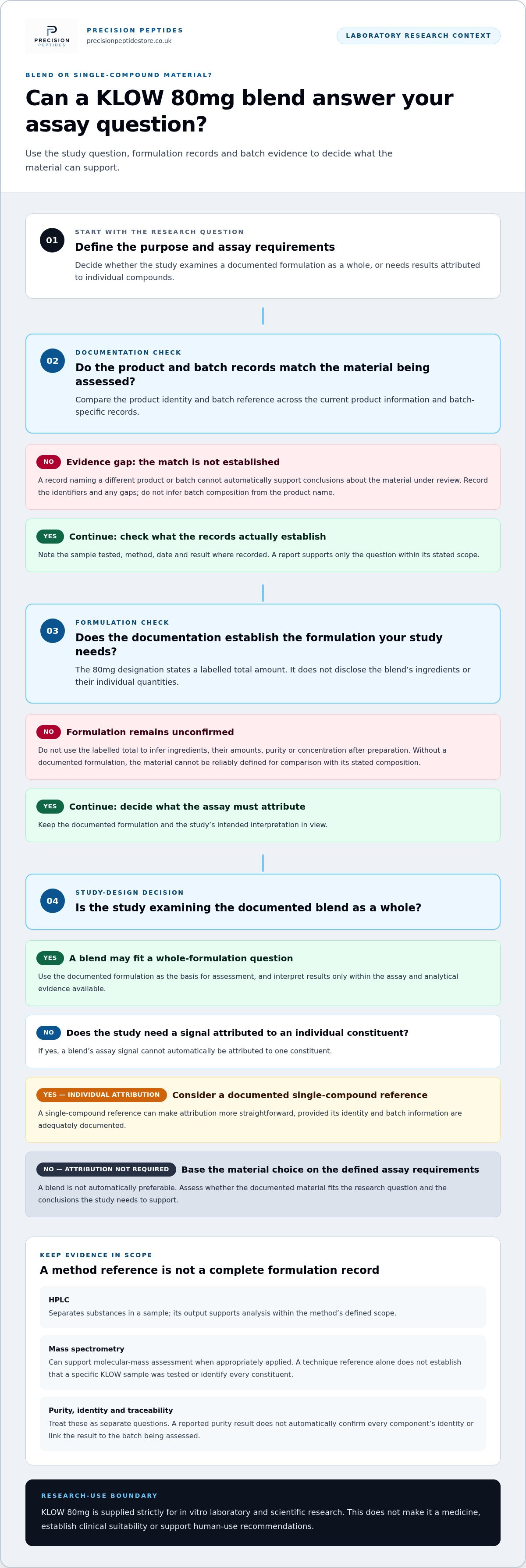
KLOW 80mg blend or single-compound research material?
Choose between a blend and a single-compound material based on the study question, not an assumption that one format is always preferable. KLOW 80mg is listed as a research blend, but establish its formulation from current product and batch documentation. Without a documented formulation, researchers cannot reliably define the material or interpret results against its stated composition.
A blend may fit research that examines the documented formulation as a whole. However, if an assay produces a signal, that result cannot automatically be attributed to one constituent. A single-compound reference can make attribution more straightforward, provided its identity and batch information are adequately documented. In either case, conclusions should remain within the limits of the experimental model and evidence collected.
| Research consideration | Blend | Single compound |
|---|---|---|
| Study question | Assess the documented blend as a whole. | Assess a defined compound in the chosen model. |
| Documentation | Requires formulation details and relevant batch records. | Requires compound identity and batch records. |
| Result attribution | A signal may not identify which constituent contributed. | Attribution is more direct, subject to assay design and controls. |
When might a research blend fit an assay plan?
A blend may fit when the assay is designed to examine that complete, documented material rather than isolate the contribution of one constituent. Confirm that the formulation records match the product and batch under review, then define controls and interpretation limits in advance. An observed effect in an in vitro model remains specific to that model; it does not establish a broader biological or clinical conclusion.
When is a single-compound reference more interpretable?
A defined single-compound material can simplify attribution when the research question concerns one substance. It still requires suitable controls, a clear assay plan and records identifying the tested material. Let the experimental objective guide the choice rather than a ranking of expected effects. Precision Peptides lists Retatrutide 10mg as a research product; its format does not make it interchangeable with KLOW or relevant to every study.
For UK research planning, keep product selection within the in vitro laboratory context and separate it from clinical or human-use decisions. Assess the blend’s documented formulation and batch information against the assay objective, then limit conclusions to the experimental model and evidence available.
A practical checklist for evaluating KLOW 80mg research suitability
Assess the klow 80mg peptide against a defined in vitro research question, rather than treating the product label as evidence of suitability. Keep material selection separate from laboratory protocol development: product information helps establish what material is being considered, while the study protocol defines how the assay is designed and conducted.
Use this sequence before making a selection:
- Define the research purpose. State the assay objective and the evidence the material needs to support.
- Review formulation records. Use documented product information to establish the stated formulation; do not infer components or proportions from the product name.
- Match batch information. Check that the product identity and batch reference align across the records relevant to your assessment.
- Check assay requirements. Consider whether the documented material and analytical information address the study’s needs, including any requirement to attribute results to particular components.
Match product documentation to the planned in vitro study
Start with the assay objective, then identify which product and batch evidence is relevant to that analysis. Assess a record by its scope, not simply its presence: it may address one question without establishing every aspect of formulation or composition. Record any missing or unclear information as a study limitation instead of filling the gap with an assumption.
Product selection and protocol development are related but distinct. The first asks whether the documented material aligns with the research question. The second belongs within the laboratory’s established methods, controls and oversight. Keeping these tasks separate supports evidence-led selection without turning product descriptions into experimental instructions.
Keep research records clear and reproducible
In the study record, capture the product identity, batch reference and receipt details, along with the documentation consulted. Record preparation and storage decisions in line with applicable laboratory protocols, and use consistent terminology when describing the blend and experimental conditions. Clear records make it easier to trace what was assessed and interpret findings within the limits of the assay.
Before proceeding, confirm that the material is being considered strictly for in vitro laboratory and scientific research, and that the study’s documentation needs are understood. This checklist supports a reasoned selection decision; it does not establish assay performance or predict an outcome.
For a product-specific starting point, review KLOW 80mg research information against your defined study requirements.
KLOW 80mg from Precision Peptides: product context and next steps
KLOW 80mg is a listed research blend in the Precision Peptides catalogue, supplied strictly for in vitro laboratory and scientific research. Its product name and labelled amount do not replace formulation or batch evidence. For a defined study, assess the product and batch information against the research question, assay model and documentation requirements.
What to establish before selecting a research blend
Begin by defining what the assay is intended to examine and what evidence is needed to interpret its results. Then assess whether the formulation information and relevant batch records relate to the material under consideration and support the planned evaluation. Treat a missing or ambiguous detail as a limitation rather than filling the gap with an assumption.
This is a product-selection decision for laboratory research, not a clinical or therapeutic assessment. Research material must not be treated as a medicine or as a basis for personal-use decisions. Keeping these boundaries clear helps maintain accurate study records and prevents product descriptions from being mistaken for clinical claims.
Where KLOW 80mg sits in the Precision Peptides catalogue
Precision Peptides is a UK-based online supplier serving customers nationally across the United Kingdom. KLOW 80mg is included in its research catalogue for laboratory and scientific research purposes. The catalogue listing establishes the product context; study suitability depends on the research requirements and the product and batch information relevant to the material being evaluated.
Before proceeding, align three elements: the assay objective, the documented formulation and the batch reference. This provides a clear basis for deciding whether the klow 80mg peptide fits the intended in vitro evaluation, while keeping conclusions within the limits of the available evidence and experimental model.
View the KLOW 80mg research product listing to review the product information for your laboratory research requirements.
Make a documented choice for your research
Assess the klow 80mg peptide through three separate considerations: documented formulation, batch-specific information and fit with your defined in vitro study. The 80mg label alone cannot establish composition or suitability, and an assay result from a blend should not automatically be attributed to one component. Keeping these distinctions clear supports traceable interpretation within appropriate limits.
KLOW 80mg is a listed Precision Peptides research blend, supplied strictly for in vitro laboratory and scientific research. Precision Peptides is a UK-based supplier serving customers nationally. Compare the product and relevant batch information with your assay requirements, and keep product selection separate from clinical, therapeutic or personal-use decisions.
View KLOW 80mg for laboratory research and review the product information against your study needs. A careful, evidence-led selection provides a sound starting point for research planning.
Frequently Asked Questions
What is KLOW 80mg peptide?
KLOW 80mg is a listed research blend supplied by Precision Peptides strictly for in vitro laboratory and scientific research. The product name identifies the listed blend, but it is not a complete formulation record. Establish what a particular product or batch contains from its current product and batch documentation rather than drawing conclusions from the name alone.
What does 80mg mean on a KLOW peptide product?
The 80mg designation refers to the labelled total amount, not necessarily the amount of any individual constituent. It does not establish purity, concentration after preparation or an expected study outcome. Read it alongside formulation-specific and batch information, then assess whether those records provide the detail needed for the planned in vitro work.
What is in the KLOW 80mg peptide blend?
KLOW 80mg is listed as a research blend, but do not infer its ingredients or their individual quantities from the product name. Refer to current product and relevant batch documentation for formulation details. This matters for study design: without a documented formulation, an assay result cannot reliably be related to a particular constituent.
How can I assess a KLOW 80mg Certificate of Analysis?
Check whether the document identifies the relevant product and batch. Then review its stated sample, analytical method, date and reported result, where provided. Consider what the method can establish and whether the document’s scope matches your research question. Use a certificate or test result as evidence only when the relevant documentation is available and linked to the material being assessed.
Is KLOW 80mg intended for human use?
No. KLOW 80mg is supplied strictly for in vitro laboratory and scientific research, not for human use. It is not presented as a medicine or as a clinical or therapeutic product. Keep its assessment within a defined laboratory research context, and do not use product descriptions as human-use recommendations.
How should researchers compare KLOW 80mg with a single-compound research peptide?
Base the comparison on the research question, available formulation records and the need to attribute results. A documented blend may suit a study of the blend as a whole, while a defined single-compound material can make attribution more straightforward. Neither format is inherently preferable for every study; assay design and supporting evidence determine which is more interpretable.
Can KLOW 80mg be used in any in vitro assay?
No single product can be assumed to suit every assay. Assess whether the documented formulation and batch information align with the assay objective, model and interpretation requirements. Consider the controls and whether the study needs to distinguish component-specific effects. Product selection does not replace laboratory protocol development, and conclusions should remain limited to the experimental model and evidence.
Frequently Asked Questions
The 80mg designation states a labelled total amount. It does not show how that amount is divided between constituents, establish purity or indicate concentration after preparation. Mass alone also cannot predict a biological effect or study outcome. For formulation-specific information, compare the product description with the batch records and check that they identify the same product and batch. Read analytical evidence in context. A method’s result supports only the question it was designed to address. A label, a formulation record and an analytical report serve different purposes, so do not treat them as interchangeable evidence.
Compare the product name and batch identifier across the product information and batch-specific records. Where recorded, note the sample tested, analytical method, date and result. Then check whether the record addresses the question you need answered. A result for a sample does not, by itself, disclose every component or establish that every unit in a batch has identical characteristics. Keep the review auditable. Record the documents consulted, the identifiers they show and any gaps that affect interpretation. Treat a Certificate of Analysis or test result as evidence only when it is provided and clearly linked to the relevant product and batch.
A blend may fit when the assay is designed to examine that complete, documented material rather than isolate the contribution of one constituent. Confirm that the formulation records match the product and batch under review, then define controls and interpretation limits in advance. An observed effect in an in vitro model remains specific to that model; it does not establish a broader biological or clinical conclusion.
A defined single-compound material can simplify attribution when the research question concerns one substance. It still requires suitable controls, a clear assay plan and records identifying the tested material. Let the experimental objective guide the choice rather than a ranking of expected effects. Precision Peptides lists Retatrutide 10mg as a research product; its format does not make it interchangeable with KLOW or relevant to every study. For UK research planning, keep product selection within the in vitro laboratory context and separate it from clinical or human-use decisions. Assess the blend’s documented formulation and batch information against the assay objective, then limit conclusions to the experimental model and evidence available. Assess the klow 80mg peptide against a defined in vitro research question, rather than treating the product label as evidence of suitability. Keep material selection separate from laboratory protocol development: product information helps establish what material is being considered, while the study protocol defines how the assay is designed and conducted. Use this sequence before making a selection:
KLOW 80mg is a listed research blend supplied by Precision Peptides strictly for in vitro laboratory and scientific research. The product name identifies the listed blend, but it is not a complete formulation record. Establish what a particular product or batch contains from its current product and batch documentation rather than drawing conclusions from the name alone.
The 80mg designation refers to the labelled total amount, not necessarily the amount of any individual constituent. It does not establish purity, concentration after preparation or an expected study outcome. Read it alongside formulation-specific and batch information, then assess whether those records provide the detail needed for the planned in vitro work.
KLOW 80mg is listed as a research blend, but do not infer its ingredients or their individual quantities from the product name. Refer to current product and relevant batch documentation for formulation details. This matters for study design: without a documented formulation, an assay result cannot reliably be related to a particular constituent.
Check whether the document identifies the relevant product and batch. Then review its stated sample, analytical method, date and reported result, where provided. Consider what the method can establish and whether the document’s scope matches your research question. Use a certificate or test result as evidence only when the relevant documentation is available and linked to the material being assessed.
No. KLOW 80mg is supplied strictly for in vitro laboratory and scientific research, not for human use. It is not presented as a medicine or as a clinical or therapeutic product. Keep its assessment within a defined laboratory research context, and do not use product descriptions as human-use recommendations.
Base the comparison on the research question, available formulation records and the need to attribute results. A documented blend may suit a study of the blend as a whole, while a defined single-compound material can make attribution more straightforward. Neither format is inherently preferable for every study; assay design and supporting evidence determine which is more interpretable.
No single product can be assumed to suit every assay. Assess whether the documented formulation and batch information align with the assay objective, model and interpretation requirements. Consider the controls and whether the study needs to distinguish component-specific effects. Product selection does not replace laboratory protocol development, and conclusions should remain limited to the experimental model and evidence.