


BPC-157 Research Peptide UK: A Laboratory-Focused Guide
8 October 2026 · 16 min read
A research label is not evidence of clinical safety or effectiveness. When assessing a bpc 157 research peptide uk listing, that distinction matters: most available findings come from preclinical studies and cannot establish how the compound performs in people. Look beyond commercial claims and consider what the research, product identity and records actually support.
This guide explains BPC-157’s research context, the limits of current evidence and the documentation that can inform a careful laboratory evaluation. It also explains why research-use-only materials must not be confused with authorised medicines or treatments for human use.
We’ll outline how to interpret research findings, review product and batch information, and understand the UK supply context without overstating what is known. Precision Peptides lists BPC157 10mg strictly for in vitro laboratory and scientific research. That designation describes its research context, not a clinical use.
Key Takeaways
- Assess each BPC-157 study by its model, research question, controls and limitations. Findings from cells, animals and people are not interchangeable.
- Use the bpc 157 research peptide uk context to distinguish laboratory investigation from claims about human outcomes.
- Review product identity, batch reference and document consistency to support traceability in laboratory procurement.
- Check which analytical method was used and what it measures before interpreting a reported result.
- Precision Peptides’ BPC157 10mg is designated strictly for in vitro laboratory and scientific research.
What is BPC-157, and what does “research peptide” mean?
BPC-157 is a synthetic peptide studied in laboratory and preclinical research. The BPC-157 Wikipedia article summarises its reported research history and status, but a general overview is no substitute for examining the original studies. For laboratory readers, the key distinction is between a compound being investigated and evidence establishing a clinical use.
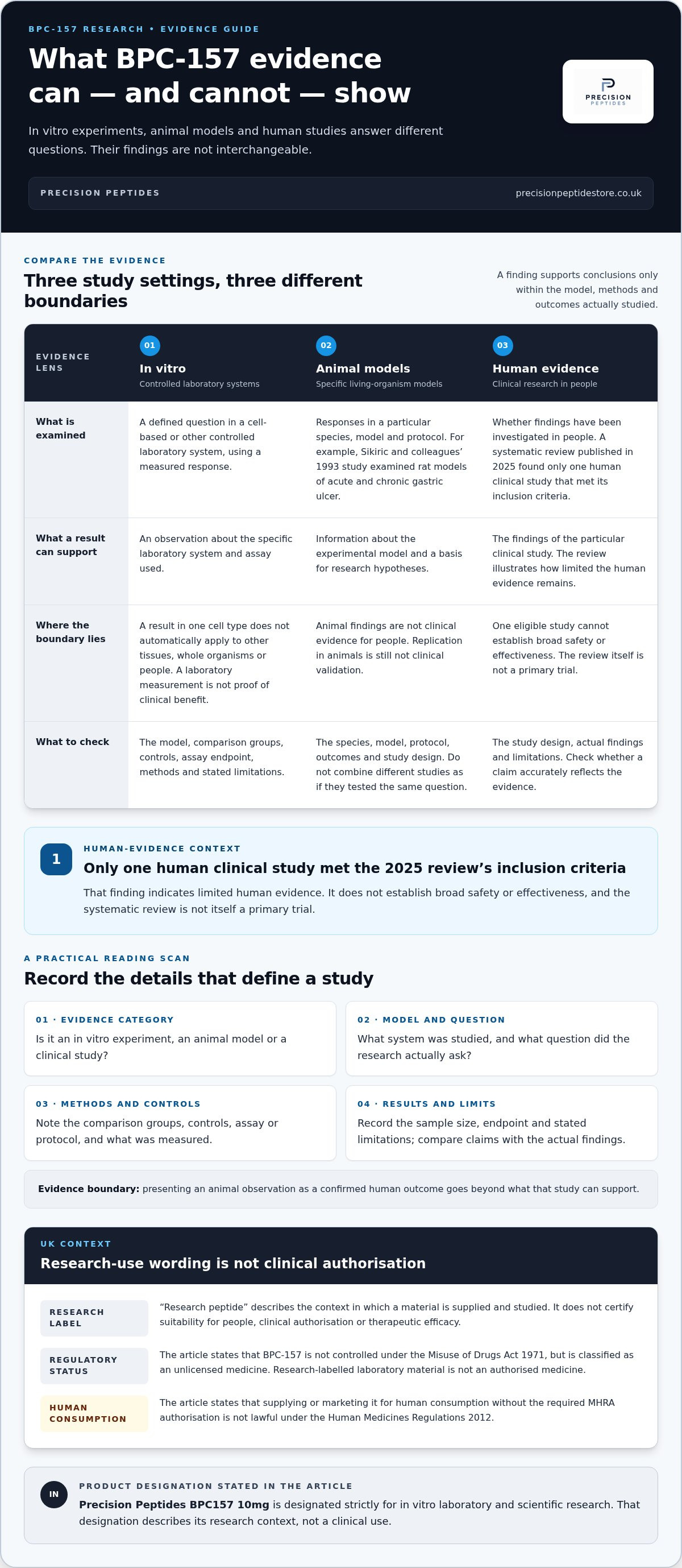
“Research peptide” describes the context in which a material is supplied and studied. It does not certify its suitability for people. In vitro experiments examine material in controlled laboratory systems, while animal studies investigate effects in specific models. Neither establishes safety or effectiveness in humans. A research-use-only label describes an intended research context, not clinical authorisation, therapeutic efficacy or a basis for personal use.
In the UK, BPC-157 is not controlled under the Misuse of Drugs Act 1971, but is classified as an unlicensed medicine. Research-labelled laboratory material is not an authorised medicine. Supplying or marketing it for human consumption without the required MHRA authorisation is not lawful under the Human Medicines Regulations 2012. A label cannot convert laboratory material into an approved treatment.
How should readers interpret the term “research peptide”?
In a laboratory setting, the term signals that a compound is intended for scientific investigation under defined protocols. Researchers assess its identity and records in light of the work being conducted. The term does not mean the material has pharmaceutical status, has been evaluated for human use or is appropriate for administration.
Trace claims back to the evidence. Identify whether a statement comes from an in vitro experiment, an animal model or a clinical study, then compare it with the study’s actual question and findings. Promotional wording that turns a laboratory observation into a human treatment conclusion crosses an evidence boundary unless suitable clinical evidence supports that step.
Why does BPC-157 attract scientific and commercial attention?
Scientific interest reflects questions researchers have examined in experimental settings, including how the compound behaves in particular laboratory systems and animal models. Those questions may justify further investigation, but they do not demonstrate a proven outcome. Each result remains specific to its model, methods and limitations.
Commercial descriptions can compress that distinction. A statement about what a study investigated is not proof that a product produces a particular effect in people. When assessing bpc 157 research peptide uk information, separate published observations from extrapolation, and treat claims about treatment or personal use as distinct from laboratory evidence. Start with the study itself: its design, measured outcomes and stated limitations.
BPC-157 research: what molecular and preclinical studies can show
Published BPC-157 research includes laboratory experiments and animal models, but these evidence types answer different questions. For example, Sikiric and colleagues’ 1993 primary study examined BPC-157 in rat models of acute and chronic gastric ulcer. Later animal research has investigated other experimental models, including tissue repair. Such findings can inform hypotheses about biological activity under specific conditions, but they do not establish effects in people.
Preclinical findings cannot demonstrate human clinical efficacy. A result observed in a cell system or animal model may not translate to human biology, safety or outcomes.
What can in vitro models tell researchers?
Cell-based experiments let researchers examine a defined question under controlled conditions, such as whether a measured response changes in a particular cell system. Interpretation depends on the model, comparison groups, controls and assay endpoint. A change in a laboratory measurement is evidence about that experiment, not proof of clinical benefit or a basis for treatment recommendations.
For each paper, identify what was measured and how the authors interpreted it. A result in one cell type cannot automatically be extended to other tissues, whole organisms or people. Replication, appropriate controls and transparent methods strengthen a finding, but do not remove the model’s limits.
Where do preclinical findings stop short?
Animal studies add information about responses in a living organism, yet their conclusions remain specific to the species, model, protocol and outcomes assessed. Sikiric et al.’s 1993 rat ulcer experiments, for instance, concern that experimental model. They are not clinical evidence for people with gastric conditions. Differences in study design also mean that results should not be combined as though every paper tested the same question.
Preclinical research is hypothesis-generating. Independent studies that reproduce a finding can make it more persuasive within its research context, but replication in animals is still not clinical validation. A systematic review published in 2025 found only one human clinical study meeting its inclusion criteria, illustrating how limited the human evidence remains. The review is not itself a primary trial, and one eligible study cannot establish broad safety or effectiveness.
When reading a paper, record its evidence category, model, sample size, controls, endpoint and stated limitations. Then check whether a promotional statement accurately reflects that design. If copy presents an animal observation as a confirmed human outcome, it goes beyond what the study can support. This distinction is central to evaluating bpc 157 research peptide uk information responsibly.
For laboratory procurement, keep the material’s intended research context separate from the strength of the scientific evidence. Precision Peptides lists BPC157 10mg strictly for in vitro laboratory and scientific research; this is not a clinical claim. Researchers reviewing this BPC157 10mg research material should assess product information separately from conclusions drawn from published studies.
How to assess BPC-157 evidence without overstating the findings
Start by matching each conclusion to the method that produced it. Laboratory interest is not proof of a treatment effect, and neither a product description nor a batch document can bridge that gap. For readers researching bpc 157 research peptide uk, separating study evidence from material documentation supports clearer interpretation.
- In vitro: Cell or other laboratory models can show responses under defined experimental conditions. They cannot establish effects in a whole person.
- Animal: Studies can examine outcomes in a particular species and model. They cannot confirm that the same outcome occurs in humans.
- Human: Clinical studies can investigate outcomes in people, but their design, participant numbers and limitations determine what can be concluded.
These categories are not interchangeable. Report a result at the level of evidence that supports it, without turning a preliminary observation into a clinical claim.
Which questions help evaluate a BPC-157 study?
Begin with the research question: what did investigators set out to test, and what outcome did they measure? Check that the model and methods support the authors’ conclusion. Then review controls, replicates, sample size and stated limitations. A clearly described method helps readers judge whether a comparison is informative. A small or exploratory study should be presented with corresponding caution.
Give priority to primary publications when tracing a specific finding. Distinguish the authors’ measured results from later summaries or promotional interpretations, and state uncertainty where evidence is preliminary, inconsistent or confined to a particular model.
What can a certificate of analysis establish?
A certificate of analysis (COA) relates to a material or batch. Its value depends on the identity of the sample, tests performed, analytical methods and scope of the reported results. Check that the document identifies the relevant batch and states what was examined. A result without those details is difficult to interpret or trace.
Identity or purity testing addresses specific analytical questions. It does not, by itself, establish sterility, safety for human use or clinical efficacy. A result for one batch does not automatically describe another. A COA supports material assessment; it is not evidence that BPC-157 has a therapeutic effect.
For a related example of how a research profile can discuss a different material, see the KLOW 80mg research profile. It concerns a blend, not BPC-157, and should not be treated as evidence about BPC-157’s properties or effects.
Keep these two assessment tracks distinct: research papers address questions about biological effects, while batch records address specified characteristics of material. Neither substitutes for the other, and neither justifies claims beyond its stated scope.
A laboratory checklist for BPC-157 identity and traceability
Reliable laboratory records connect the material received with the documentation used to assess it and the research in which it is recorded. Traceability means being able to connect a sample with its batch records. This supports auditability and helps distinguish one item or batch from another without implying anything about clinical suitability.
What information should researchers record at receipt?
At receipt, record the product identifier, batch reference and date received in the laboratory’s inventory or quality records. Retain supplier documentation with the relevant inventory entry so the link remains clear if the material is later assigned to a study. Keep procurement records separate from experimental protocols: they document receipt and identity, not experimental procedures or human use.
A practical checklist can include:
- 1. Product identifier: Record the name or identifier shown on the product and compare it with the order and accompanying documents.
- 2. Batch reference: Transcribe the batch identifier exactly, preserving any letters, numbers or punctuation.
- 3. Receipt date: Enter the date the material was received and link it to the inventory record.
- 4. Supporting documents: Retain supplied records with the relevant product and batch entry, rather than filing them without a traceable reference.
- 5. Discrepancies: Record mismatches between the label, order and documents, then handle them under the laboratory’s established quality procedures.
Consistency matters. If a batch reference differs between a label and a document, leave the discrepancy visible in the record rather than silently correcting it. This preserves an auditable account of what was received and what information was available for review.
How should researchers interpret analytical documentation?
Before interpreting a reported result, check the document’s stated method and scope. Confirm that it identifies the material and batch being assessed, then note the method, result and date. Consider what the method can establish and whether the report states any limitations. A result without a clear sample identity or testing scope is difficult to apply to a particular batch.
Do not infer sterility, stability or biological performance from a test that does not report those properties. An analytical document supports only conclusions within its stated remit. It cannot establish clinical efficacy or replace study evidence. For bpc 157 research peptide uk procurement, this distinction helps keep material records and scientific conclusions separate.
Precision Peptides lists BPC157 10mg strictly for in vitro laboratory and scientific research. The BPC157 10mg research listing provides procurement context. Assess any available batch documentation according to its stated scope.
BPC-157 research peptide UK: the Precision Peptides research-use context
Precision Peptides is a UK-based online supplier of research peptides and laboratory biochemicals, serving customers across the United Kingdom. Its catalogue includes BPC157 10mg, designated strictly for in vitro laboratory and scientific research. This is a defined research-use context, not a representation that the material is an authorised medicine or suitable for clinical or personal use.
Keep that distinction clear wherever the product is described. A catalogue entry identifies a research material; it does not endorse a treatment, establish therapeutic effects or show that a compound has been approved for human use. Assess scientific findings on their own evidence, and describe products within their stated research context.
How does research-use-only positioning define the product context?
Research-use-only wording describes the intended context of a material. It does not validate efficacy, demonstrate safety or determine regulatory status. BPC157 10mg is not offered as a clinical or therapeutic medicine. Use consistent wording in headings, captions and product references, so laboratory research is not presented as treatment guidance or medical endorsement.
Careful wording supports accurate communication. A research designation does not change the limits of the underlying evidence and should not imply outcomes for people. Keep descriptions factual: identify the material and its in vitro laboratory and scientific research designation, and leave conclusions about biological effects to properly assessed research.
What is the next responsible step for a laboratory reader?
Before considering any research material, apply the relevant institutional governance, documented procedures and study-specific review. Keep procurement records distinct from experimental conclusions, and assess product information alongside evidence and documentation appropriate to the planned laboratory work. This creates a clearer record of why a material was selected and what the available information does, and does not, establish.
When reviewing bpc 157 research peptide uk supply information, treat the product listing as a catalogue reference, not a treatment option or a substitute for regulatory, institutional or scientific review. Use precise language in internal records and communications, particularly where research materials could otherwise be mistaken for medicines or clinical services.
A responsible evaluation keeps three boundaries intact: intended research use, the scope of product documentation and the strength of published evidence. Review each in its proper context, without inferring clinical suitability or therapeutic benefit from a product designation.
For the catalogue in its stated laboratory research context, view the Precision Peptides research catalogue.
Put a clear research framework into practice
Before procurement, set out what the proposed laboratory work is intended to examine and what evidence would be relevant to that question. A short appraisal record can identify the study context, limits on conclusions and material documentation required. This gives colleagues a consistent basis for review and keeps research decisions proportionate to the evidence.
For anyone assessing bpc 157 research peptide uk information, Precision Peptides is a UK-based online supplier of research peptides and laboratory biochemicals. Its BPC157 10mg listing is designated strictly for in vitro laboratory and scientific research purposes, not as a clinical or therapeutic product. Treat the catalogue as a procurement reference and keep research decisions within your organisation’s documented governance.
When your laboratory is ready to review the catalogue, view the Precision Peptides research catalogue. Align the research question, records and intended use before proceeding.
Frequently Asked Questions
What is BPC-157?
BPC-157 is a synthetic peptide investigated in preclinical research. The name identifies the compound, not a recognised treatment or established clinical indication. In a paper or catalogue, check how the material is described and whether claims refer to laboratory experiments, animal research or human studies. This helps prevent a compound’s research history from being mistaken for proof of a particular effect in people.
Is BPC-157 approved for human use in the UK?
No. BPC-157 is not an approved medicine for human use in the UK and is classified as an unlicensed medicine. A research supplier’s product description does not grant medicine authorisation or establish that the material is suitable for people. Keep this regulatory distinction in mind when reading online claims, and refer to current MHRA guidance for authoritative information on medicines regulation.
Can BPC-157 laboratory findings prove that it works in people?
No. Laboratory and animal findings cannot, by themselves, establish that an effect will occur in humans. For example, a measured change in cultured cells may depend on the cell type, conditions and endpoint selected. Assess human research separately, including its design and limitations. Do not treat a promising experimental observation as confirmation of a clinical outcome or a reason for personal use.
What does research-use-only mean for BPC-157?
It indicates that the material is designated for research rather than offered as a medicine or treatment. The wording does not certify human safety, prove efficacy or establish regulatory approval. For example, a laboratory inventory can record the designation alongside the product identifier, while a separate study record explains the approved research question and methods. The label defines context; it does not determine what the evidence proves.
What should a BPC-157 certificate of analysis include?
A useful certificate of analysis should make clear which material and batch it concerns, what analytical method was used, the result reported and the date of testing. Researchers can compare these details with the received item and retain the document with the relevant inventory entry. A document that omits batch identity or method scope may be difficult to interpret. Assess its contents only within the stated testing remit.
Does a purity result prove that BPC-157 is effective?
No. A purity result relates to a specified analytical measurement of a sample; it does not show whether the material produces a biological effect or clinical outcome. Even a clearly reported result for a particular batch cannot establish efficacy in a laboratory model or in people. Keep analytical findings in procurement records and evaluate claims about effects against relevant published research, not a purity figure alone.
How should researchers assess claims about BPC-157?
Trace each claim to its source, then check the study type, research model, measured outcome and limitations. Ask whether the wording reflects what investigators observed or extends beyond the tested conditions. For bpc 157 research peptide uk searches, distinguish primary research from summaries and promotional copy. Record uncertainty clearly, particularly where a claim relies on a single model or lacks relevant human evidence.
Frequently Asked Questions
In a laboratory setting, the term signals that a compound is intended for scientific investigation under defined protocols. Researchers assess its identity and records in light of the work being conducted. The term does not mean the material has pharmaceutical status, has been evaluated for human use or is appropriate for administration. Trace claims back to the evidence. Identify whether a statement comes from an in vitro experiment, an animal model or a clinical study, then compare it with the study’s actual question and findings. Promotional wording that turns a laboratory observation into a human treatment conclusion crosses an evidence boundary unless suitable clinical evidence supports that step.
Scientific interest reflects questions researchers have examined in experimental settings, including how the compound behaves in particular laboratory systems and animal models. Those questions may justify further investigation, but they do not demonstrate a proven outcome. Each result remains specific to its model, methods and limitations. Commercial descriptions can compress that distinction. A statement about what a study investigated is not proof that a product produces a particular effect in people. When assessing bpc 157 research peptide uk information, separate published observations from extrapolation, and treat claims about treatment or personal use as distinct from laboratory evidence. Start with the study itself: its design, measured outcomes and stated limitations. Published BPC-157 research includes laboratory experiments and animal models, but these evidence types answer different questions. For example, Sikiric and colleagues’ 1993 primary study examined BPC-157 in rat models of acute and chronic gastric ulcer. Later animal research has investigated other experimental models, including tissue repair. Such findings can inform hypotheses about biological activity under specific conditions, but they do not establish effects in people. Preclinical findings cannot demonstrate human clinical efficacy. A result observed in a cell system or animal model may not translate to human biology, safety or outcomes.
Cell-based experiments let researchers examine a defined question under controlled conditions, such as whether a measured response changes in a particular cell system. Interpretation depends on the model, comparison groups, controls and assay endpoint. A change in a laboratory measurement is evidence about that experiment, not proof of clinical benefit or a basis for treatment recommendations. For each paper, identify what was measured and how the authors interpreted it. A result in one cell type cannot automatically be extended to other tissues, whole organisms or people. Replication, appropriate controls and transparent methods strengthen a finding, but do not remove the model’s limits.
Animal studies add information about responses in a living organism, yet their conclusions remain specific to the species, model, protocol and outcomes assessed. Sikiric et al.’s 1993 rat ulcer experiments, for instance, concern that experimental model. They are not clinical evidence for people with gastric conditions. Differences in study design also mean that results should not be combined as though every paper tested the same question. Preclinical research is hypothesis-generating. Independent studies that reproduce a finding can make it more persuasive within its research context, but replication in animals is still not clinical validation. A systematic review published in 2025 found only one human clinical study meeting its inclusion criteria, illustrating how limited the human evidence remains. The review is not itself a primary trial, and one eligible study cannot establish broad safety or effectiveness. When reading a paper, record its evidence category, model, sample size, controls, endpoint and stated limitations. Then check whether a promotional statement accurately reflects that design. If copy presents an animal observation as a confirmed human outcome, it goes beyond what the study can support. This distinction is central to evaluating bpc 157 research peptide uk information responsibly. For laboratory procurement, keep the material’s intended research context separate from the strength of the scientific evidence. Precision Peptides lists BPC157 10mg strictly for in vitro laboratory and scientific research; this is not a clinical claim. Researchers reviewing this BPC157 10mg research material should assess product information separately from conclusions drawn from published studies. Start by matching each conclusion to the method that produced it. Laboratory interest is not proof of a treatment effect, and neither a product description nor a batch document can bridge that gap. For readers researching bpc 157 research peptide uk, separating study evidence from material documentation supports clearer interpretation. These categories are not interchangeable. Report a result at the level of evidence that supports it, without turning a preliminary observation into a clinical claim.
Begin with the research question: what did investigators set out to test, and what outcome did they measure? Check that the model and methods support the authors’ conclusion. Then review controls, replicates, sample size and stated limitations. A clearly described method helps readers judge whether a comparison is informative. A small or exploratory study should be presented with corresponding caution. Give priority to primary publications when tracing a specific finding. Distinguish the authors’ measured results from later summaries or promotional interpretations, and state uncertainty where evidence is preliminary, inconsistent or confined to a particular model.
A certificate of analysis (COA) relates to a material or batch. Its value depends on the identity of the sample, tests performed, analytical methods and scope of the reported results. Check that the document identifies the relevant batch and states what was examined. A result without those details is difficult to interpret or trace. Identity or purity testing addresses specific analytical questions. It does not, by itself, establish sterility, safety for human use or clinical efficacy. A result for one batch does not automatically describe another. A COA supports material assessment; it is not evidence that BPC-157 has a therapeutic effect. For a related example of how a research profile can discuss a different material, see the KLOW 80mg research profile. It concerns a blend, not BPC-157, and should not be treated as evidence about BPC-157’s properties or effects. Keep these two assessment tracks distinct: research papers address questions about biological effects, while batch records address specified characteristics of material. Neither substitutes for the other, and neither justifies claims beyond its stated scope. Reliable laboratory records connect the material received with the documentation used to assess it and the research in which it is recorded. Traceability means being able to connect a sample with its batch records. This supports auditability and helps distinguish one item or batch from another without implying anything about clinical suitability.
At receipt, record the product identifier, batch reference and date received in the laboratory’s inventory or quality records. Retain supplier documentation with the relevant inventory entry so the link remains clear if the material is later assigned to a study. Keep procurement records separate from experimental protocols: they document receipt and identity, not experimental procedures or human use. A practical checklist can include: Consistency matters. If a batch reference differs between a label and a document, leave the discrepancy visible in the record rather than silently correcting it. This preserves an auditable account of what was received and what information was available for review.
Before interpreting a reported result, check the document’s stated method and scope. Confirm that it identifies the material and batch being assessed, then note the method, result and date. Consider what the method can establish and whether the report states any limitations. A result without a clear sample identity or testing scope is difficult to apply to a particular batch. Do not infer sterility, stability or biological performance from a test that does not report those properties. An analytical document supports only conclusions within its stated remit. It cannot establish clinical efficacy or replace study evidence. For bpc 157 research peptide uk procurement, this distinction helps keep material records and scientific conclusions separate. Precision Peptides lists BPC157 10mg strictly for in vitro laboratory and scientific research. The BPC157 10mg research listing provides procurement context. Assess any available batch documentation according to its stated scope. Precision Peptides is a UK-based online supplier of research peptides and laboratory biochemicals, serving customers across the United Kingdom. Its catalogue includes BPC157 10mg, designated strictly for in vitro laboratory and scientific research. This is a defined research-use context, not a representation that the material is an authorised medicine or suitable for clinical or personal use. Keep that distinction clear wherever the product is described. A catalogue entry identifies a research material; it does not endorse a treatment, establish therapeutic effects or show that a compound has been approved for human use. Assess scientific findings on their own evidence, and describe products within their stated research context.
Research-use-only wording describes the intended context of a material. It does not validate efficacy, demonstrate safety or determine regulatory status. BPC157 10mg is not offered as a clinical or therapeutic medicine. Use consistent wording in headings, captions and product references, so laboratory research is not presented as treatment guidance or medical endorsement. Careful wording supports accurate communication. A research designation does not change the limits of the underlying evidence and should not imply outcomes for people. Keep descriptions factual: identify the material and its in vitro laboratory and scientific research designation, and leave conclusions about biological effects to properly assessed research.
Before considering any research material, apply the relevant institutional governance, documented procedures and study-specific review. Keep procurement records distinct from experimental conclusions, and assess product information alongside evidence and documentation appropriate to the planned laboratory work. This creates a clearer record of why a material was selected and what the available information does, and does not, establish. When reviewing bpc 157 research peptide uk supply information, treat the product listing as a catalogue reference, not a treatment option or a substitute for regulatory, institutional or scientific review. Use precise language in internal records and communications, particularly where research materials could otherwise be mistaken for medicines or clinical services. A responsible evaluation keeps three boundaries intact: intended research use, the scope of product documentation and the strength of published evidence. Review each in its proper context, without inferring clinical suitability or therapeutic benefit from a product designation. For the catalogue in its stated laboratory research context, view the Precision Peptides research catalogue. Before procurement, set out what the proposed laboratory work is intended to examine and what evidence would be relevant to that question. A short appraisal record can identify the study context, limits on conclusions and material documentation required. This gives colleagues a consistent basis for review and keeps research decisions proportionate to the evidence. For anyone assessing bpc 157 research peptide uk information, Precision Peptides is a UK-based online supplier of research peptides and laboratory biochemicals. Its BPC157 10mg listing is designated strictly for in vitro laboratory and scientific research purposes, not as a clinical or therapeutic product. Treat the catalogue as a procurement reference and keep research decisions within your organisation’s documented governance. When your laboratory is ready to review the catalogue, view the Precision Peptides research catalogue. Align the research question, records and intended use before proceeding.
BPC-157 is a synthetic peptide investigated in preclinical research. The name identifies the compound, not a recognised treatment or established clinical indication. In a paper or catalogue, check how the material is described and whether claims refer to laboratory experiments, animal research or human studies. This helps prevent a compound’s research history from being mistaken for proof of a particular effect in people.
No. BPC-157 is not an approved medicine for human use in the UK and is classified as an unlicensed medicine. A research supplier’s product description does not grant medicine authorisation or establish that the material is suitable for people. Keep this regulatory distinction in mind when reading online claims, and refer to current MHRA guidance for authoritative information on medicines regulation.
No. Laboratory and animal findings cannot, by themselves, establish that an effect will occur in humans. For example, a measured change in cultured cells may depend on the cell type, conditions and endpoint selected. Assess human research separately, including its design and limitations. Do not treat a promising experimental observation as confirmation of a clinical outcome or a reason for personal use.
It indicates that the material is designated for research rather than offered as a medicine or treatment. The wording does not certify human safety, prove efficacy or establish regulatory approval. For example, a laboratory inventory can record the designation alongside the product identifier, while a separate study record explains the approved research question and methods. The label defines context; it does not determine what the evidence proves.
A useful certificate of analysis should make clear which material and batch it concerns, what analytical method was used, the result reported and the date of testing. Researchers can compare these details with the received item and retain the document with the relevant inventory entry. A document that omits batch identity or method scope may be difficult to interpret. Assess its contents only within the stated testing remit.
No. A purity result relates to a specified analytical measurement of a sample; it does not show whether the material produces a biological effect or clinical outcome. Even a clearly reported result for a particular batch cannot establish efficacy in a laboratory model or in people. Keep analytical findings in procurement records and evaluate claims about effects against relevant published research, not a purity figure alone.
Trace each claim to its source, then check the study type, research model, measured outcome and limitations. Ask whether the wording reflects what investigators observed or extends beyond the tested conditions. For bpc 157 research peptide uk searches, distinguish primary research from summaries and promotional copy. Record uncertainty clearly, particularly where a claim relies on a single model or lacks relevant human evidence.