
Peptide Reconstitution for Laboratory Use: A Controlled, Repeatable Approach
3 October 2026 · 15 min read
A generic reconstitution recipe can introduce more uncertainty than consistency. For peptide reconstitution for laboratory use, start with an authorised, compound-specific procedure, not an assumed solvent or set of preparation conditions.
A repeatable method also depends on protecting sample integrity. Solvent compatibility, handling requirements and storage conditions can differ between compounds, so a protocol that suits one material should not be applied automatically to another. Before preparation, confirm the sample identity, review the relevant product and safety information, and follow the laboratory’s approved procedure.
This article explains how to plan and document in vitro peptide preparation without relying on one-size-fits-all instructions. It covers how to identify the applicable protocol, reduce avoidable handling variation, and record compound identity, batch details, preparation conditions and calculated final concentration. These controls make research results easier to interpret and support reproducible work, while keeping preparation decisions grounded in the specific material and its documented requirements.
Key Takeaways
- For peptide reconstitution for laboratory use, begin with an authorised, compound-specific SOP rather than a generic preparation recipe.
- Check that the compound identity, batch reference and intended in vitro method match the relevant documentation.
- Keep supplier analytical records, laboratory preparation logs and assay records distinct. Each supports a different part of the research trail.
- Reduce avoidable variation by organising sample handling, labelling and storage around the approved procedure.
- Record deviations and calculated final concentration clearly. A certificate of analysis does not validate your reconstitution method or assay.
Peptide reconstitution for laboratory use: what the process involves
Peptide reconstitution for laboratory use means preparing lyophilised material for a defined in vitro laboratory application under an authorised, compound-specific procedure. It is not a universal recipe: the applicable documentation and method determine the preparation conditions.
Reconstitution quality means preparing a specified sample for a defined laboratory application in a controlled, documented way. This goes beyond adding liquid. Sample identity, the procedure and the preparation record all matter.
What lyophilised peptide reconstitution means in a laboratory
Lyophilisation is freeze-drying, a process that removes water from frozen material under controlled conditions. This overview of freeze-dried peptides describes the process. Reconstitution prepares supplied material for laboratory use; it differs from diluting an already prepared solution, which has a different starting material and preparation history.
Conditions can vary with the compound, its formulation and the intended analytical method. A diluent suitable for one material or assay may not suit another. Generic solvent suggestions and concentration calculators therefore cannot replace compound-specific documentation and an approved SOP.
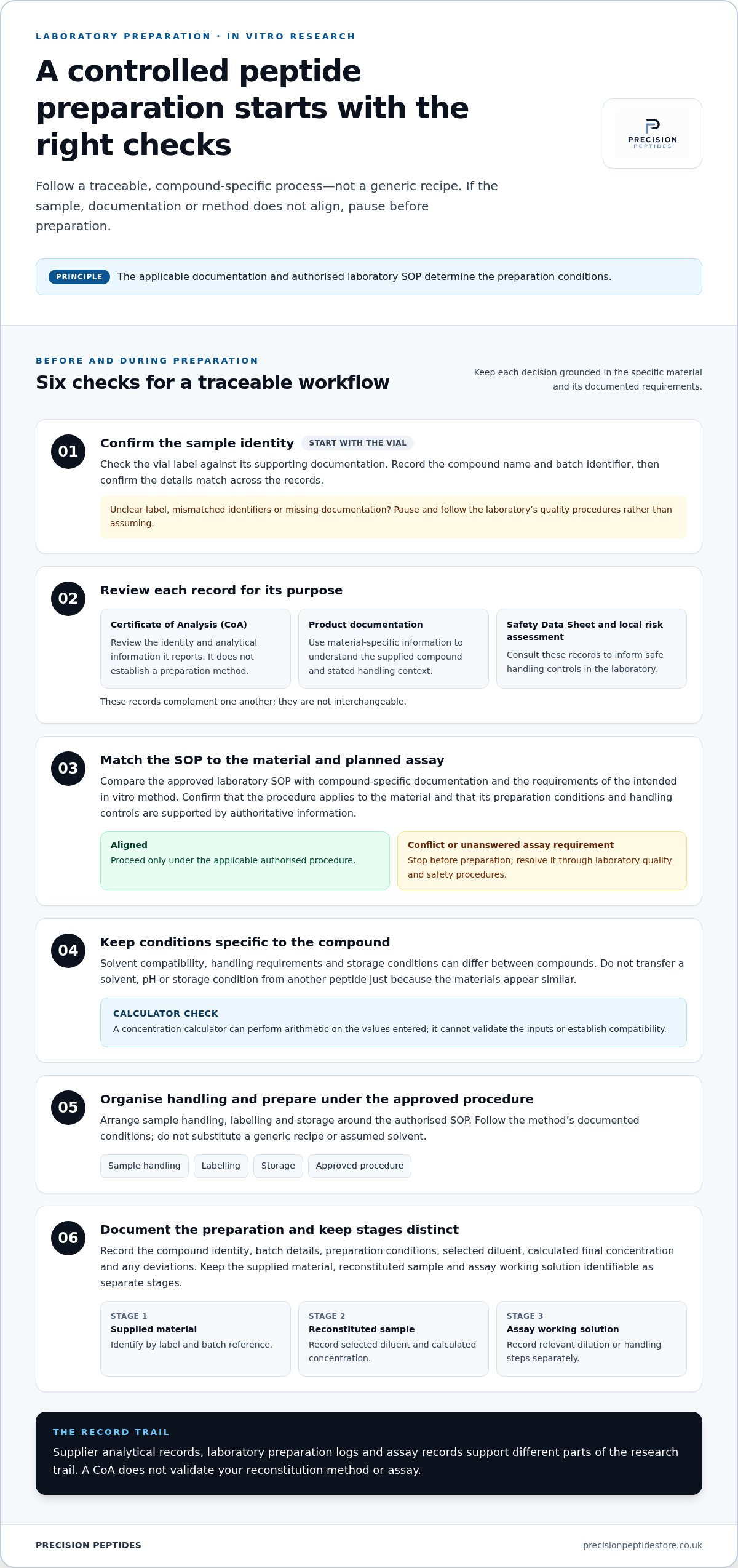
Keep three stages distinct: the supplied material, the reconstituted sample and any assay working solution prepared from it. Identify the supplied material by its label and batch reference. In the preparation record, capture the selected diluent and calculated concentration. Record the working solution separately, including the dilution or handling steps relevant to its assay.
Why research-use boundaries matter
This article concerns controlled in vitro laboratory and scientific research only. It does not provide instructions for human administration, clinical use, dosing or treatment. Research preparation must remain within the intended laboratory application and the controls established by the institution.
Before work begins, follow institutional procedures and consult the relevant product documentation and safety data. These records have different roles: product information identifies the material and its documented context, while safety documentation informs risk controls. Neither should be replaced by assumptions based on another peptide or a general preparation guide.
Reliable preparation depends on a traceable chain: confirm the sample, apply the authorised method and record what was done. If the identity, documentation or method does not align, pause and resolve the discrepancy through the laboratory’s established procedures before preparation.
Before reconstituting a peptide, check identity, documentation, and compatibility
Preparation should begin with a document review, not a choice of diluent. For peptide reconstitution for laboratory use, confirm that the vial, supporting records and planned in vitro method refer to the same material and intended application. A calculator can help with arithmetic, but it cannot establish whether a solvent or preparation condition is compatible with a particular compound or assay.
Which records should be reviewed first?
Check the vial label against the accompanying documentation before handling. Record the compound name and batch identifier, then confirm that the details match across the records. If the label is unclear, identifiers do not match or relevant documentation is missing, pause and follow the laboratory’s quality procedures instead of proceeding on an assumption.
Review each record for its specific purpose:
- Certificate of Analysis (CoA): review the identity and analytical information it reports, and consider its relevance to the research plan. It does not establish a preparation method.
- Product documentation: use material-specific information to understand the supplied compound and any stated handling context.
- Safety Data Sheet (SDS) and local risk assessment: consult these to inform safe handling controls in the laboratory.
These records complement one another but are not interchangeable. A CoA may support assessment of a batch, while the SOP governs the laboratory procedure and safety documentation informs risk management.
For product context, view Retatrutide 10mg and other research peptides. Product information is not a reconstitution protocol; preparation conditions must come from an authorised, applicable method.
How to assess protocol and material compatibility
Before selecting preparation conditions, compare the approved laboratory SOP with the compound-specific documentation and the requirements of the planned assay. Check that the method applies to the material and intended in vitro use, and that its stated diluent, concentration approach and handling controls are supported by authoritative information.
Do not transfer a solvent, pH or storage condition from another peptide simply because the materials appear similar. A concentration calculator cannot resolve compatibility either. It can calculate from the values entered, but it cannot validate those inputs.
If the SOP conflicts with product documentation, or the assay requirements are not addressed, stop before preparation. Escalate the discrepancy through the laboratory’s quality and safety procedures, and document the resolution. Researchers reviewing in vitro materials can explore research peptides and laboratory biochemicals, then use the applicable documentation and approved SOP to guide preparation decisions.
A controlled peptide reconstitution workflow for in vitro research
A repeatable workflow follows an authorised method from set-up through to storage. For peptide reconstitution for laboratory use, use a validated, compound-specific procedure and the laboratory’s safety controls, rather than adapting instructions for a different material or application. The sequence is practical: authorise the SOP, prepare the workspace, handle the sample as directed, complete the records and store the prepared material as specified.
A concentration calculation cannot establish compatibility. Verify the material, diluent and assay requirements against the approved method before using the calculated value. Calculations support the procedure; they do not validate its inputs.
Prepare the workspace and materials under the local SOP
Before beginning, confirm that the work area is appropriate for the task, the required protective equipment is available, and the materials named in the SOP are approved for the intended in vitro work. Follow local instructions for handling and contamination control. Do not substitute materials or change controls based on habit or convenience.
Start the preparation record before handling the sample. Capture the compound identity, batch reference, operator, date and identifier or version of the authorised procedure. These details connect the material to the method used and make the preparation traceable. If the SOP, sample information or required materials do not align, pause and use the laboratory’s established quality and safety procedures to resolve the issue.
Handle the sample and document the prepared solution
Carry out the approved method as written. If the sample’s appearance or behaviour differs from what the procedure describes, do not improvise. Pause, record the observation and escalate it through the appropriate laboratory process. This protects sample integrity and keeps the preparation record accurate.
Use the laboratory’s controlled template to record the required preparation details, including permitted deviations and their authorisation. Document the calculated final concentration, its calculation basis and any preparation steps needed to interpret or repeat the work. Distinguish the prepared sample from any later assay working solution, recording subsequent dilution or handling separately where applicable.
Label the resulting sample in accordance with local procedure. Make its identity, batch traceability, concentration, preparation date and applicable handling information clear, without relying on memory or a note that could become separated from the sample. Store it under the conditions specified by the authorised method and record its location or status where the laboratory system requires this.
For relevant in vitro research context, review research peptides and laboratory biochemicals alongside the documentation and procedures governing your work.
How to reduce variability, contamination, and avoidable sample loss
Reproducibility depends on separating controllable preparation differences from variation that may arise from the compound, assay or equipment. For peptide reconstitution for laboratory use, consistent adherence to the approved SOP, reliable sample identification and complete records help reduce preventable variation. They cannot remove every source of difference, but they make results easier to interpret.
Small process gaps can have practical consequences. An unclear label can break the link between a result and its batch. Uncontrolled handling can increase contamination risk. An undocumented deviation leaves uncertainty about how the sample was prepared. An assay response may have several possible causes, so interpretation should consider the documented method, material and equipment rather than assume a single explanation.
Common sources of variation during preparation
Use the authorised procedure consistently, and link the compound identity and batch reference to each preparation and assay record. Note relevant equipment or method differences in the laboratory’s controlled documentation. If batches or assay results differ, preserve that context for review rather than treating the difference as proof of a preparation error.
Appearance alone cannot reliably confirm identity, purity, concentration or suitability. If a sample looks unexpected, record the observation and follow the laboratory’s review process. Do not diagnose the cause from appearance or apply unvalidated corrective steps, such as changing the preparation method, to obtain a preferred result.
A documented deviation records what differed from the approved method; it does not, by itself, establish that preparation failed. This distinction supports an evidence-based investigation, rather than an assumption that either the sample or the method is valid.
Storage, deviations, and sample disposition
Use compound-specific evidence and the approved SOP to determine post-preparation storage conditions and stability limits. Do not transfer storage assumptions from another peptide. Maintain the sample’s identity and batch traceability during storage, and link the preparation to its subsequent use or status in the laboratory records.
If a deviation occurs, document what happened, when it occurred and which material may be affected. Assess it through the laboratory’s quality process before deciding whether the sample remains suitable for its intended in vitro work. If contamination or compromised integrity is suspected, do not rely on appearance or make an informal salvage decision. Quarantine or dispose of the material according to institutional procedures, and retain the relevant records.
For in vitro research, view research peptides for laboratory study as product context, while using the applicable SOP and compound-specific documentation to govern handling and storage.
From preparation records to reliable research: quality checks and next steps
Reliable interpretation depends on a traceable record from supplied material to assay result. In peptide reconstitution for laboratory use, supplier analytical records, laboratory preparation logs and assay records serve different purposes. Together, they help researchers assess provenance, preparation history and experimental context, but none should be treated as evidence for a purpose it was not designed to establish.
What a COA can and cannot establish
A Certificate of Analysis (COA) can provide batch-linked identity and analytical information. This may support assessment of the supplied material when interpreted within the document’s stated scope. It is one part of the evidence trail, not a complete validation of laboratory use.
Purity data alone do not establish that a particular solvent is compatible, that a prepared sample will remain stable under specific conditions, or that it will perform as intended in an assay. A COA also does not validate the laboratory’s reconstitution method or the suitability of its assay. Those questions require applicable compound-specific information, controlled laboratory procedures and appropriate assay controls.
The preparation log records what the laboratory did: the sample and batch, authorised procedure, actual preparation details, operator and relevant deviations. The assay record captures the method, conditions and results needed to interpret the experiment. Supplier records support material traceability; preparation and assay records establish the laboratory context. Each contributes a distinct link to the research record.
A practical close-out checklist for the research record
Before closing the preparation record, check that the core information is present and connected to the relevant assay:
- Identity: sample identifier, compound name and batch reference.
- Method: authorised SOP identifier or version, operator and preparation date.
- Handling: recorded concentration, applicable storage information and any deviations, including their disposition.
- Research link: reference to the assay record and any related analytical information.
Retain records under local document-control procedures so another authorised researcher can follow the material’s history without relying on recollection. Clear links between batch, preparation and assay support review when results differ and help distinguish documented facts from assumptions.
Verify identity, follow the authorised SOP and retain an auditable record. This approach supports controlled in vitro research; these materials are not for human administration, clinical use or treatment. To explore materials supplied strictly for laboratory and scientific research, explore research peptides.
Make each preparation traceable and repeatable
Reliable peptide reconstitution for laboratory use starts with material-specific evidence, an authorised procedure and records that connect the supplied batch to the resulting assay. A Certificate of Analysis can inform assessment of the material, but it cannot validate your preparation method or establish assay performance.
Keep the process controlled: verify identity and compatibility before preparation, follow the laboratory SOP, and document handling, concentration and any deviations. These steps help distinguish preventable variation from differences associated with the compound, equipment or assay, giving researchers a clearer basis for reviewing results and planning subsequent work.
Precision Peptides supplies research compounds, including Retatrutide and Mounjaro, to research customers across the United Kingdom. Products are supplied strictly for in vitro laboratory and scientific research, not for human administration, clinical use or treatment. To view research materials, explore research peptides.
With compound-specific checks and an auditable preparation record in place, your laboratory can proceed with greater clarity and confidence.
Frequently Asked Questions
What does peptide reconstitution mean in laboratory research?
Peptide reconstitution means preparing lyophilised, or freeze-dried, material for a defined laboratory application by following an authorised method. For peptide reconstitution for laboratory use, the method should be specific to the compound and intended in vitro research. It is distinct from diluting an already prepared solution. Record the sample identity, batch reference, preparation conditions and calculated concentration so the sample’s history can be traced and interpreted.
How do I choose a diluent for a research peptide?
Choose a diluent only when it is specified by an applicable, authoritative method or approved laboratory SOP for that compound and intended assay. Compatibility can depend on the material’s formulation and the analytical method, so a general recommendation or a choice used for another peptide may not apply. Review the relevant product documentation and local safety information. If the records conflict or leave compatibility unresolved, pause and follow the laboratory’s quality procedures.
Can I use the same reconstitution method for every peptide?
No. Preparation conditions may differ between compounds, formulations and intended assays. Reusing a method simply because it worked for another material can introduce unsupported assumptions about solvent compatibility, handling or storage. Apply a validated, compound-specific procedure and confirm that it is appropriate for the planned in vitro work. If no applicable method is available, do not improvise; resolve the gap through the laboratory’s established quality and safety process before preparation.
How should I calculate a peptide solution concentration?
Use the amount of material and final solution volume specified or established by the authorised method, keeping units consistent. In principle, concentration is the amount of peptide divided by the final solution volume. Record the values and calculation basis in the preparation log, then distinguish the prepared sample concentration from any later assay working concentration. Arithmetic does not confirm that the chosen diluent or preparation conditions are compatible with the peptide.
What happens if a reconstituted peptide looks cloudy or different than expected?
An unexpected appearance does not, by itself, identify the cause or confirm a sample’s identity, purity or suitability. Do not diagnose a failed preparation from appearance alone, and do not attempt an unvalidated correction. Record what you observe and refer to the compound-specific method and laboratory SOP. If the observation raises concerns about contamination or sample integrity, pause use and follow institutional procedures for review, quarantine or disposal.
How should reconstituted peptides be stored for laboratory research?
Use the storage conditions and stability limits supported by compound-specific evidence and the authorised laboratory SOP. These may vary, so do not apply a temperature, duration or storage practice from another peptide without supporting documentation. Record the required handling information, preparation date and storage history in the laboratory record. If the applicable instructions are unclear or a storage deviation occurs, document it and follow the laboratory’s process for assessing the sample.
Does a Certificate of Analysis provide a reconstitution protocol?
A Certificate of Analysis (COA) provides batch-linked analytical information within the scope of that document; it is not, by itself, a laboratory reconstitution protocol. Purity or identity data do not establish solvent compatibility, storage stability or performance in a particular assay. Use the COA to support material traceability, then follow the applicable compound-specific documentation and approved SOP. Keep preparation and assay records as separate, linked evidence of laboratory handling and experimental results.
Frequently Asked Questions
Check the vial label against the accompanying documentation before handling. Record the compound name and batch identifier, then confirm that the details match across the records. If the label is unclear, identifiers do not match or relevant documentation is missing, pause and follow the laboratory’s quality procedures instead of proceeding on an assumption. Review each record for its specific purpose: These records complement one another but are not interchangeable. A CoA may support assessment of a batch, while the SOP governs the laboratory procedure and safety documentation informs risk management. For product context, view Retatrutide 10mg and other research peptides. Product information is not a reconstitution protocol; preparation conditions must come from an authorised, applicable method.
Peptide reconstitution means preparing lyophilised, or freeze-dried, material for a defined laboratory application by following an authorised method. For peptide reconstitution for laboratory use, the method should be specific to the compound and intended in vitro research. It is distinct from diluting an already prepared solution. Record the sample identity, batch reference, preparation conditions and calculated concentration so the sample’s history can be traced and interpreted.
Choose a diluent only when it is specified by an applicable, authoritative method or approved laboratory SOP for that compound and intended assay. Compatibility can depend on the material’s formulation and the analytical method, so a general recommendation or a choice used for another peptide may not apply. Review the relevant product documentation and local safety information. If the records conflict or leave compatibility unresolved, pause and follow the laboratory’s quality procedures.
No. Preparation conditions may differ between compounds, formulations and intended assays. Reusing a method simply because it worked for another material can introduce unsupported assumptions about solvent compatibility, handling or storage. Apply a validated, compound-specific procedure and confirm that it is appropriate for the planned in vitro work. If no applicable method is available, do not improvise; resolve the gap through the laboratory’s established quality and safety process before preparation.
Use the amount of material and final solution volume specified or established by the authorised method, keeping units consistent. In principle, concentration is the amount of peptide divided by the final solution volume. Record the values and calculation basis in the preparation log, then distinguish the prepared sample concentration from any later assay working concentration. Arithmetic does not confirm that the chosen diluent or preparation conditions are compatible with the peptide.
An unexpected appearance does not, by itself, identify the cause or confirm a sample’s identity, purity or suitability. Do not diagnose a failed preparation from appearance alone, and do not attempt an unvalidated correction. Record what you observe and refer to the compound-specific method and laboratory SOP. If the observation raises concerns about contamination or sample integrity, pause use and follow institutional procedures for review, quarantine or disposal.
Use the storage conditions and stability limits supported by compound-specific evidence and the authorised laboratory SOP. These may vary, so do not apply a temperature, duration or storage practice from another peptide without supporting documentation. Record the required handling information, preparation date and storage history in the laboratory record. If the applicable instructions are unclear or a storage deviation occurs, document it and follow the laboratory’s process for assessing the sample.
A Certificate of Analysis (COA) provides batch-linked analytical information within the scope of that document; it is not, by itself, a laboratory reconstitution protocol. Purity or identity data do not establish solvent compatibility, storage stability or performance in a particular assay. Use the COA to support material traceability, then follow the applicable compound-specific documentation and approved SOP. Keep preparation and assay records as separate, linked evidence of laboratory handling and experimental results.