


Retatrutide 10mg Research Vial: A UK Laboratory Sourcing Guide
2 October 2026 · 15 min read
What does “10mg” actually confirm about a retatrutide 10mg research vial? It states the labelled amount, but does not establish the vial’s identity, contents or batch-specific quality. Those details need to be checked against records that relate to the product being considered.
Before making a laboratory procurement decision, look for clear product specifications and documentation you can review. Retatrutide remains investigational and is not approved or licensed for use in the UK. A research-use label does not make a vial an approved medicine or establish that it is suitable for human or veterinary use. Precision Peptides lists Retatrutide 10mg strictly for in vitro laboratory and scientific research.
This guide explains what the 10mg format does and does not tell you, how to assess supplier information, and which product-specific details to verify. It also covers research-use boundaries and practical checks to document before deciding whether the available information is adequate for your laboratory’s purposes.
Key Takeaways
- Read “10mg” as a stated product amount, not proof of identity, quality or a particular physical presentation.
- For a retatrutide 10mg research vial, compare the product listing and label, then check whether records identify the batch, analytical method and document date.
- Assess each analytical record in context. Check its batch link, method and description of the sample tested.
- Compare suppliers on documentation access, batch traceability and clearly stated use restrictions, rather than relying on unsupported purity or quality claims.
- Before procurement, confirm the research purpose, product details and supplier terms. The stated supply scope is in vitro laboratory and scientific research, not human or veterinary use.
Retatrutide 10mg research vial: what the product description does and does not establish
A research vial is a laboratory-supply format described for in vitro scientific work. That description does not make it an authorised medicine, a treatment or a route to clinical access. Precision Peptides lists Retatrutide 10mg strictly for in vitro laboratory and scientific research. Before procurement, compare the current product-page wording and label with any supplier documentation. Do not assume that a listing alone verifies the contents of a particular vial.
Definition: A retatrutide 10mg research vial is a product described by its supplier as containing a stated 10mg amount for laboratory research. The listing alone does not prove batch identity, purity, concentration or suitability for use beyond its stated research scope.
What does “10mg research vial” mean on a product listing?
The “10mg” designation is a stated product amount, not a dosing instruction. On its own, it does not establish concentration, formulation, the quantity available for a particular laboratory procedure or preparation requirements. Do not infer those details from the number or the word “vial”.
Compare the current label and product description with the supplier documentation. If analytical records are available, check whether they identify the batch under consideration. A product-page description is a supplier statement; an analytical document may provide further evidence, but its value depends on its batch link, stated method and sample context. If these cannot be matched or assessed, record the point as unverified rather than making an assumption.
What retatrutide research context is relevant to procurement?
Retatrutide is an investigational compound studied in scientific settings. Research describes it as acting on GLP-1, GIP and glucagon receptors. That background does not establish the identity or quality of a specific supplier vial. The Retatrutide overview summarises its mechanism, development history and clinical-trial context.
For procurement, keep the distinction clear: research on a compound does not establish that a product listing represents an authorised medicine or provides clinical access. A research-use label does not verify the contents either. Assess the stated amount, product identity and available records separately, and retain the documentation used in your decision. The supply scope must remain in vitro laboratory and scientific research, not human or veterinary use.
How to assess retatrutide 10mg vial specifications and batch records
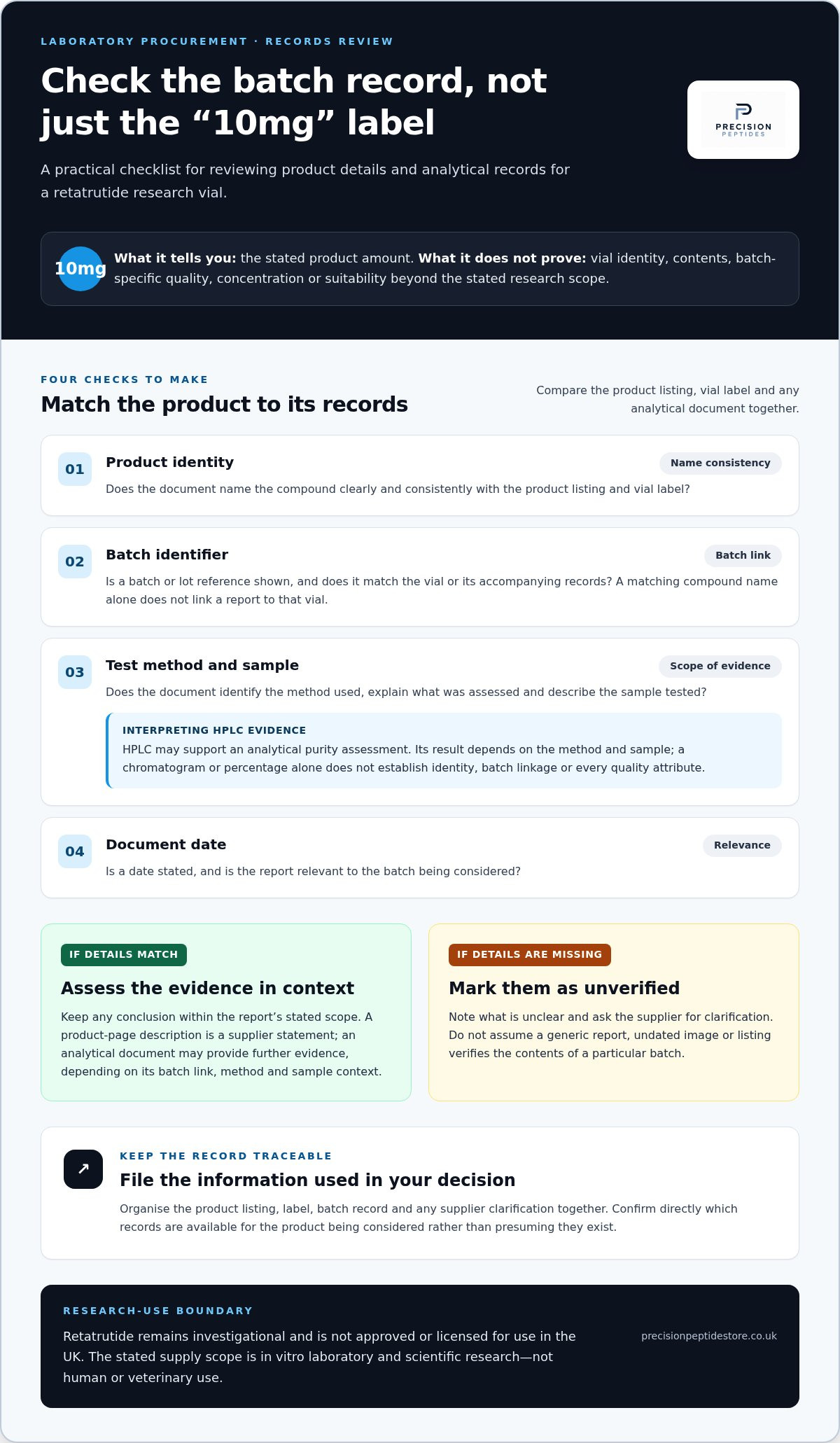
A useful records review connects the product description to the specific material being considered. For a retatrutide 10mg research vial, compare the compound name and stated amount across the product listing, vial label and any supplied analytical document. A matching name is a useful first check, but does not prove that a report relates to that vial.
Check these four details before drawing conclusions:
- Product identity: Does the document name the compound clearly and consistently?
- Batch identifier: Is a batch or lot reference shown, and does it match the vial or its accompanying records?
- Test method: Does the document identify the method used and explain what was assessed?
- Document date: Is a date stated, and is the report relevant to the batch being considered?
If a detail is missing, unclear or inconsistent, note it and ask the supplier for clarification. Do not assume that a generic report, an undated image or a product-page statement verifies the contents of a particular batch. Precision Peptides lists Retatrutide 10mg, but confirm directly which records are available for the product being considered rather than presuming they exist.
Which details should a laboratory purchaser check first?
Review the listing, label and records together. First, check that the compound name and stated 10mg amount agree. Then look for a batch identifier linking the document to the vial under review. Note the document date and what the report covers. If a field is missing or ambiguous, ask for clarification and keep the response with your procurement records.
How should analytical evidence be interpreted?
High-performance liquid chromatography (HPLC) may support an analytical purity assessment, but the result depends on the method used and the sample tested. A chromatogram or percentage alone does not establish identity, batch linkage or every quality attribute. Interpret any conclusion only within the report’s stated scope. Do not apply an assumed purity threshold or infer that Precision Peptides provides a certificate of analysis.
For more detail on reading these documents, consult the separate retatrutide COA explainer. UK laboratory procurement also requires attention to appropriate handling and regulatory context. The Health and Safety Executive provides guidance on the UK REACH regulation. Check the requirements relevant to the substance and intended laboratory activities rather than assuming how they apply.
Before deciding, organise the product listing, label, batch record and any supplier clarification in one traceable file. You can use the Precision Peptides research catalogue as a starting point, then verify the current product details and available batch-specific documentation.
Retatrutide 10mg research vial supplier claims: what can be compared fairly?
A fair supplier comparison uses the same criteria for every listing and separates claims from records that can be reviewed. For a retatrutide 10mg research vial, a product description may state an identity, amount or research-use restriction. Do not treat these statements as batch-specific analytical evidence unless supporting documentation links them to the material under consideration.
Use this framework to record what is stated, what is documented and what still needs clarification:
| Criterion | What to check | How to record it |
|---|---|---|
| Identity | Do the listing, label and any report name the same compound and state the same amount? | Note the matching details and any discrepancies. |
| Batch linkage | Does the record identify a batch or lot that can be matched to the vial under consideration? | Mark the link as documented, unclear or not provided. |
| Test method | Does the document name the analytical method and describe what it assesses? | Capture the method and stated scope, not just a headline result. |
| Document access | Can you review the relevant record, and does it include a date? | Record what was supplied and when it was reviewed. |
| Use restrictions | Are the stated research-only limits clear and consistent across the listing and terms? | Keep the stated restrictions with the procurement record. |
Which supplier criteria are relevant to laboratory procurement?
Prioritise traceable product identification, accessible documentation and explicit research-use terms. Assess fulfilment information separately: check whether dispatch or delivery details are current and supported by the supplier’s present terms, but do not use them as evidence of product identity or quality. Before placing a research order, record any unanswered questions, such as a missing batch reference or unclear document scope.
How can a comparison avoid misleading quality claims?
A supplier’s purity statement is a claim. A result in an analytical record can support an assessment only when the method, sample and batch connection are clear. Do not compare purity figures as if they were equivalent when the underlying methods or evidence differ. An analytical result also does not prove sterility, safety or suitability for a particular purpose.
Missing information is a reason to request clarification, not proof of a defect. Apply the same standard to every supplier, including Precision Peptides, and distinguish between information confirmed in a document and information that remains unverified. That gives you a more useful comparison than ranking suppliers by unqualified claims.
UK research-use boundaries and a responsible retatrutide procurement checklist
A responsible procurement decision starts with purpose and ends with a documented record. Precision Peptides states that its products are supplied strictly for in vitro laboratory and scientific research, not for clinical, therapeutic or compounded human use. Consider a retatrutide 10mg research vial only within an appropriate research setting and under your laboratory’s own governance procedures.
Research-use labelling does not authorise human use.
Retatrutide is investigational and is not an authorised medicine or treatment in the UK. A research product is not a prescription alternative, and the supplier’s stated scope does not settle every regulatory question for a purchaser. Check current statements with the relevant UK authorities, including the MHRA, and seek appropriate institutional or regulatory advice if the intended purpose or applicable requirements are unclear.
What does research-use-only mean for this purchase?
For this supplier, the stated scope is in vitro laboratory and scientific research. It excludes human and veterinary use. Treat that restriction as a procurement boundary, not as an assurance of regulatory approval or a substitute for checking the requirements that apply to your organisation, activities and handling procedures.
What should be recorded before an order is placed?
Keep a concise, traceable procurement file. Record the research purpose, product name and stated amount, available batch information, documents reviewed and any supplier clarifications. Retain relevant correspondence and order records within your laboratory procedures. If the intended use, documentation or regulatory position remains unclear, escalate the question before proceeding.
- Confirm purpose: Document the in vitro research rationale and relevant internal approval.
- Check identity: Compare the current listing and label details, and note any discrepancy.
- Review records: Record which batch-specific documents were available and what they establish.
- Check terms: Confirm the supplier’s current use restrictions and ordering terms.
- Resolve uncertainty: Seek clarification or appropriate advice before placing an order.
Do not infer legal permission from a supplier’s label or from the fact that a product is available online. UK regulatory statements can change and may depend on the circumstances, so check current authoritative guidance rather than relying on broad assurances. This checklist helps document what you considered; it is not legal advice or confirmation that a particular procurement is permitted.
For a product-specific starting point, review the Retatrutide 10mg listing and verify its current label, available records and research-use terms before making a documented decision.
Sourcing Retatrutide 10mg from Precision Peptides: verify the record before ordering
Precision Peptides is a UK-based online supplier with Retatrutide 10mg listed in its catalogue. That confirms the catalogue item, not the details of a particular vial, batch or order. Before deciding, compare the stated 10mg product with its current label and available documentation. Check, too, that the intended work falls within the stated in vitro laboratory and scientific research scope.
What should be confirmed on the current product listing?
Review the current listing alongside any label information and linked documents. Check that the product name and stated amount agree across the materials, and whether any records identify the batch being considered. If a document’s scope or batch connection is unclear, ask the supplier for clarification instead of treating a general product statement as evidence about a specific item.
Check current fulfilment terms directly before ordering. Stock status, dispatch arrangements and delivery timing can change, so do not infer them from an older page, a search result or another supplier’s information. Keep a record of the terms reviewed and any response received.
- Product details: Confirm the current product name, stated amount and label information.
- Supporting records: Establish which documents are available and whether they relate to the relevant batch.
- Supplier terms: Review current use restrictions and fulfilment information.
What is the appropriate next step for a laboratory buyer?
Proceed only when product identity, relevant records and intended research scope are sufficiently clear for your laboratory’s procedures. Keep the listing, documents, supplier correspondence and order record together so the basis for your decision is traceable. If a specification remains ambiguous, pause and resolve the question before procurement.
Products are supplied strictly for in vitro laboratory and scientific research, not for clinical, therapeutic, compounded, human or veterinary use. The research-use scope should be compatible with the documented purpose and your organisation’s requirements. A catalogue listing is not a substitute for either assessment.
Once those checks are complete, you can review Precision Peptides’ research-use catalogue and confirm the current Retatrutide 10mg listing and available records before ordering.
Make your procurement decision with a clear record
Assess a retatrutide 10mg research vial through three separate checks: confirm what the current listing and label state, establish whether available records relate to the relevant batch, and ensure the intended work fits the supplier’s stated research-use scope. The 10mg designation alone does not establish purity, concentration or batch-specific quality.
Precision Peptides is a UK-based supplier with Retatrutide 10mg listed in its catalogue. Its stated supply scope is in vitro laboratory and scientific research only, not clinical, therapeutic, compounded, human or veterinary use. Before ordering, verify the current product details, available documentation and supplier terms, then retain the records supporting your laboratory’s decision.
As a starting point, review Precision Peptides’ research-use catalogue and check the current Retatrutide 10mg listing against your procurement requirements. A measured, documented review helps keep the decision transparent and aligned with your laboratory procedures.
Frequently Asked Questions
What is a retatrutide 10mg research vial?
A retatrutide 10mg research vial is a supplier-listed laboratory research product bearing a stated amount of 10mg. The label alone does not establish purity, concentration, physical presentation or suitability for a particular assay. Check the current product labelling and ask which batch-linked records are available before procurement. It is described for in vitro research, not as a medicine or treatment, and is not for human or veterinary use.
Is retatrutide 10mg a medicine available for human use?
No. A research-use product listing is not an authorised medicine or a treatment option. Precision Peptides states that its products are supplied strictly for in vitro laboratory and scientific research, not for clinical, therapeutic or compounded human use. Do not interpret online research availability as permission for self-administration. If legal status is relevant to your work, check current UK regulatory information with the appropriate authority rather than relying on a supplier’s description alone.
What should a retatrutide 10mg vial certificate of analysis include?
Check whether the record names the compound, identifies a batch, states the analytical method and includes a document date. Confirm that its batch reference matches the vial under consideration and that the report explains what was tested. A certificate or purity figure does not establish every quality attribute. Ask the supplier which records are currently available; do not assume a certificate exists or applies to a particular batch.
How can I verify a retatrutide research vial supplier?
Compare the product name and stated amount across the listing, label and any available batch records. Check whether research-use restrictions are clear and whether documentation can be reviewed. Treat marketing statements as supplier claims unless matching records support them. Apply the same criteria to each supplier, note unanswered questions and request clarification. For regulatory matters, consult current authoritative UK sources rather than relying solely on a product page.
Can a retatrutide research vial be used for personal treatment?
No. A research-use product is not supplied as a medicine for personal treatment, and its label does not establish clinical suitability or authorisation. This article cannot provide dosing, administration or self-experimentation guidance. Anyone seeking treatment should speak with an appropriate healthcare professional and use medicines through lawful clinical pathways. Keep research procurement and clinical care separate, and do not treat a supplier listing as medical advice or a prescription alternative.
Does a 10mg label tell me the vial concentration or purity?
No. The stated 10mg amount does not, by itself, establish concentration, analytical purity, physical presentation or the quantity suitable for a particular laboratory procedure. Confirm the current label and review relevant records, checking whether they identify the batch and explain the analytical method and sample context. If information is missing or unclear, ask the supplier for clarification before considering the product within your laboratory’s approved research procedures.
Frequently Asked Questions
The “10mg” designation is a stated product amount, not a dosing instruction. On its own, it does not establish concentration, formulation, the quantity available for a particular laboratory procedure or preparation requirements. Do not infer those details from the number or the word “vial”. Compare the current label and product description with the supplier documentation. If analytical records are available, check whether they identify the batch under consideration. A product-page description is a supplier statement; an analytical document may provide further evidence, but its value depends on its batch link, stated method and sample context. If these cannot be matched or assessed, record the point as unverified rather than making an assumption.
Retatrutide is an investigational compound studied in scientific settings. Research describes it as acting on GLP-1, GIP and glucagon receptors. That background does not establish the identity or quality of a specific supplier vial. The Retatrutide overview summarises its mechanism, development history and clinical-trial context. For procurement, keep the distinction clear: research on a compound does not establish that a product listing represents an authorised medicine or provides clinical access. A research-use label does not verify the contents either. Assess the stated amount, product identity and available records separately, and retain the documentation used in your decision. The supply scope must remain in vitro laboratory and scientific research, not human or veterinary use. A useful records review connects the product description to the specific material being considered. For a retatrutide 10mg research vial, compare the compound name and stated amount across the product listing, vial label and any supplied analytical document. A matching name is a useful first check, but does not prove that a report relates to that vial. Check these four details before drawing conclusions: If a detail is missing, unclear or inconsistent, note it and ask the supplier for clarification. Do not assume that a generic report, an undated image or a product-page statement verifies the contents of a particular batch. Precision Peptides lists Retatrutide 10mg, but confirm directly which records are available for the product being considered rather than presuming they exist.
Review the listing, label and records together. First, check that the compound name and stated 10mg amount agree. Then look for a batch identifier linking the document to the vial under review. Note the document date and what the report covers. If a field is missing or ambiguous, ask for clarification and keep the response with your procurement records.
High-performance liquid chromatography (HPLC) may support an analytical purity assessment, but the result depends on the method used and the sample tested. A chromatogram or percentage alone does not establish identity, batch linkage or every quality attribute. Interpret any conclusion only within the report’s stated scope. Do not apply an assumed purity threshold or infer that Precision Peptides provides a certificate of analysis. For more detail on reading these documents, consult the separate retatrutide COA explainer. UK laboratory procurement also requires attention to appropriate handling and regulatory context. The Health and Safety Executive provides guidance on the UK REACH regulation. Check the requirements relevant to the substance and intended laboratory activities rather than assuming how they apply. Before deciding, organise the product listing, label, batch record and any supplier clarification in one traceable file. You can use the Precision Peptides research catalogue as a starting point, then verify the current product details and available batch-specific documentation. A fair supplier comparison uses the same criteria for every listing and separates claims from records that can be reviewed. For a retatrutide 10mg research vial, a product description may state an identity, amount or research-use restriction. Do not treat these statements as batch-specific analytical evidence unless supporting documentation links them to the material under consideration. Use this framework to record what is stated, what is documented and what still needs clarification:
Prioritise traceable product identification, accessible documentation and explicit research-use terms. Assess fulfilment information separately: check whether dispatch or delivery details are current and supported by the supplier’s present terms, but do not use them as evidence of product identity or quality. Before placing a research order, record any unanswered questions, such as a missing batch reference or unclear document scope.
A supplier’s purity statement is a claim. A result in an analytical record can support an assessment only when the method, sample and batch connection are clear. Do not compare purity figures as if they were equivalent when the underlying methods or evidence differ. An analytical result also does not prove sterility, safety or suitability for a particular purpose. Missing information is a reason to request clarification, not proof of a defect. Apply the same standard to every supplier, including Precision Peptides, and distinguish between information confirmed in a document and information that remains unverified. That gives you a more useful comparison than ranking suppliers by unqualified claims. A responsible procurement decision starts with purpose and ends with a documented record. Precision Peptides states that its products are supplied strictly for in vitro laboratory and scientific research, not for clinical, therapeutic or compounded human use. Consider a retatrutide 10mg research vial only within an appropriate research setting and under your laboratory’s own governance procedures. Research-use labelling does not authorise human use. Retatrutide is investigational and is not an authorised medicine or treatment in the UK. A research product is not a prescription alternative, and the supplier’s stated scope does not settle every regulatory question for a purchaser. Check current statements with the relevant UK authorities, including the MHRA, and seek appropriate institutional or regulatory advice if the intended purpose or applicable requirements are unclear.
For this supplier, the stated scope is in vitro laboratory and scientific research. It excludes human and veterinary use. Treat that restriction as a procurement boundary, not as an assurance of regulatory approval or a substitute for checking the requirements that apply to your organisation, activities and handling procedures.
Keep a concise, traceable procurement file. Record the research purpose, product name and stated amount, available batch information, documents reviewed and any supplier clarifications. Retain relevant correspondence and order records within your laboratory procedures. If the intended use, documentation or regulatory position remains unclear, escalate the question before proceeding. Do not infer legal permission from a supplier’s label or from the fact that a product is available online. UK regulatory statements can change and may depend on the circumstances, so check current authoritative guidance rather than relying on broad assurances. This checklist helps document what you considered; it is not legal advice or confirmation that a particular procurement is permitted. For a product-specific starting point, review the Retatrutide 10mg listing and verify its current label, available records and research-use terms before making a documented decision. Precision Peptides is a UK-based online supplier with Retatrutide 10mg listed in its catalogue. That confirms the catalogue item, not the details of a particular vial, batch or order. Before deciding, compare the stated 10mg product with its current label and available documentation. Check, too, that the intended work falls within the stated in vitro laboratory and scientific research scope.
Review the current listing alongside any label information and linked documents. Check that the product name and stated amount agree across the materials, and whether any records identify the batch being considered. If a document’s scope or batch connection is unclear, ask the supplier for clarification instead of treating a general product statement as evidence about a specific item. Check current fulfilment terms directly before ordering. Stock status, dispatch arrangements and delivery timing can change, so do not infer them from an older page, a search result or another supplier’s information. Keep a record of the terms reviewed and any response received.
Proceed only when product identity, relevant records and intended research scope are sufficiently clear for your laboratory’s procedures. Keep the listing, documents, supplier correspondence and order record together so the basis for your decision is traceable. If a specification remains ambiguous, pause and resolve the question before procurement. Products are supplied strictly for in vitro laboratory and scientific research, not for clinical, therapeutic, compounded, human or veterinary use. The research-use scope should be compatible with the documented purpose and your organisation’s requirements. A catalogue listing is not a substitute for either assessment. Once those checks are complete, you can review Precision Peptides’ research-use catalogue and confirm the current Retatrutide 10mg listing and available records before ordering. Assess a retatrutide 10mg research vial through three separate checks: confirm what the current listing and label state, establish whether available records relate to the relevant batch, and ensure the intended work fits the supplier’s stated research-use scope. The 10mg designation alone does not establish purity, concentration or batch-specific quality. Precision Peptides is a UK-based supplier with Retatrutide 10mg listed in its catalogue. Its stated supply scope is in vitro laboratory and scientific research only, not clinical, therapeutic, compounded, human or veterinary use. Before ordering, verify the current product details, available documentation and supplier terms, then retain the records supporting your laboratory’s decision. As a starting point, review Precision Peptides’ research-use catalogue and check the current Retatrutide 10mg listing against your procurement requirements. A measured, documented review helps keep the decision transparent and aligned with your laboratory procedures.
A retatrutide 10mg research vial is a supplier-listed laboratory research product bearing a stated amount of 10mg. The label alone does not establish purity, concentration, physical presentation or suitability for a particular assay. Check the current product labelling and ask which batch-linked records are available before procurement. It is described for in vitro research, not as a medicine or treatment, and is not for human or veterinary use.
No. A research-use product listing is not an authorised medicine or a treatment option. Precision Peptides states that its products are supplied strictly for in vitro laboratory and scientific research, not for clinical, therapeutic or compounded human use. Do not interpret online research availability as permission for self-administration. If legal status is relevant to your work, check current UK regulatory information with the appropriate authority rather than relying on a supplier’s description alone.
Check whether the record names the compound, identifies a batch, states the analytical method and includes a document date. Confirm that its batch reference matches the vial under consideration and that the report explains what was tested. A certificate or purity figure does not establish every quality attribute. Ask the supplier which records are currently available; do not assume a certificate exists or applies to a particular batch.
Compare the product name and stated amount across the listing, label and any available batch records. Check whether research-use restrictions are clear and whether documentation can be reviewed. Treat marketing statements as supplier claims unless matching records support them. Apply the same criteria to each supplier, note unanswered questions and request clarification. For regulatory matters, consult current authoritative UK sources rather than relying solely on a product page.
No. A research-use product is not supplied as a medicine for personal treatment, and its label does not establish clinical suitability or authorisation. This article cannot provide dosing, administration or self-experimentation guidance. Anyone seeking treatment should speak with an appropriate healthcare professional and use medicines through lawful clinical pathways. Keep research procurement and clinical care separate, and do not treat a supplier listing as medical advice or a prescription alternative.
No. The stated 10mg amount does not, by itself, establish concentration, analytical purity, physical presentation or the quantity suitable for a particular laboratory procedure. Confirm the current label and review relevant records, checking whether they identify the batch and explain the analytical method and sample context. If information is missing or unclear, ask the supplier for clarification before considering the product within your laboratory’s approved research procedures.